The Israeli Government has now joined the long standing Catholic tradition and hobby of banning Jewish Religious works. Unfortunately, throughout history, it was often apostates who were working for the censors who were the force behind the censorship throughout history, being exercised as late as 1901 on the first volume of the Jewish Encyclopedia, in which a passage relating to Alexander III. was blotted out in copies admitted into the czar's dominions. In the latest case, it was Anti-religious Jews who brought about the censorship as well.
The banned book, published by the IDF titled ספר מזוזה בצה"ל discussing the Halakhot of Mezuzah in the IDF, apparently did not fit the views of some of the Israeli public.The offending parts included a discussion on the requirement of a Mezuzah on a room that is used by non-Jewish soldiers as well, and a discussion regarding women affixing Mezuzot.
It turns out, that the halakhic views now have to be politically correct to be published. Zahava Gal-On a Meretz Knesset Member said "the problem with the Megalomaniacs in the IDF Rabbinate is, that they forget that they are still under the rule of the Israeli law and don't live in the Halakhic country which they fantasize about". The fact that the book is a halakhic work and not a world constitution is lost on her it seems. And this comes from a woman, who declared herself to be of "very liberal and pluralist views".
It will be seen in time if this will become a new trend in Israel, and we might perhaps be able to get back to those nostalgic middle ages, we all so miss. Other great candidates for censorship might include the Mishneh Torah ( stoning of Sabbath decorators), the Book of Joshua (Yehoshua killing Canaanites), the Talmud (very racist) etc.
Sunday, June 16, 2013

Friday, June 7, 2013
R. Mordecai b. Zevi Hirsch Klatchko (c.1858-1932) Photos of him before and after arriving in America
In 1932, just after the author's death, his work Techelet Mordechai was published. Interestingly, preceding the title page is 2 photos of the author, one before he arrived in America and one after his arrival in Boston.

|
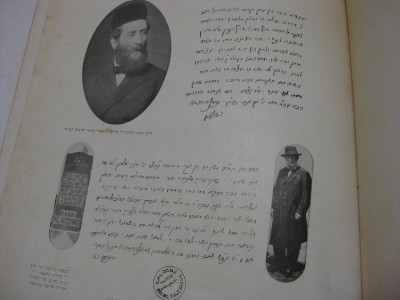
Notice the different hats, and the loss of the "Brisker Peyos"
R. Mordecai b. Zevi Hirsch Klatchko (c.1858-1932) was born in Vilna and educated in Volozhin. He served for many years in Bangor before moving to Boston (1928?)
Wednesday, June 5, 2013
Interesting Collection of Telegrams sent from Chabad Shluchim in 1949-1950 to Rabbi Shlomo Aaron Kazarnovsky
I just cataloged a nice collection of 41 telegrams sent to Rabbi Shlomo Aharon Kazarnovsky, one of the Most famous Shluchim of old, very close to the former and last Rebbes of Lubavitch.
Many of the telegrams came from famous shulchim throughout America and other notables.
The telegrams were sent on the engagement of his son, Rabbi Moshe Kazarnovsky, in 1949.
Below are some of the names the telegrams came from:
RABBI MENDEL SCHNEERSOHN
REBBETZIN CHANA SCHNEERSOHN
RABBI AND MRS Z SCHNEERSOHN
RABBI AND MRS SOLOMON HECHT-CHICAGO
RABBI BAUMGARTEN-KANSAS CITY
RABBI AXELROD-BALTIMORE
MIZRACHI WOMEN OF BORO PARK
RABBI A. POOCK, PRINCIPAL OF BETH RIVKA SCHOOLS
RABBI CUNIN
RABBI SHOLOM RIVKIN- ST LOUIS
DINAH SCHNEERSOHN
RABBI SHUSTERMAN-CHICAGO
PINCHOS ZLATA ALTHAUZ-TEL AVIV
YETTA AND MOE KESTENBAUM
RABBI SHOLOM GORDON-NEWARK
LADYS (SIC) AUXILIARY YESHIVA OHEL MOSHE
RABBI AND MRS ABRAHAM HECHT 25
An interesting look in to the early days of Chabad in America.


Sunday, June 2, 2013
Fascinating Kethubah from NYC, dated 1885, written on 4 pages.


Above is a fascinating early American Kethuba I discovered recently. Bound at end of Sepher Likute Tzvi,
collected ethical prayers and readings, is an AMERICAN KETHUBAH in a
square Ashkenazic script dated, NY 1885.
The Sefer Likute Tzvi was published in Sulzbach in 1802.
The
two leaf ketubah is written in brown ink in a cursive script with the
names of the bride and groom penciled in a cursive script. The final
leaf of the Ketubah is pasted on the final index of the end of the work.
The names of the witnesses are signed in ink at end of Kethubah. The
place of the Marriage is recorded in the Ketubah as being Cong. Shaare
Beracha, in the city of NY BeMedinat Amerika.
Following Ketubah is a loose page with
one side containing the blessings to be said under the Huppah and on
reverse in pencil is recorded the actual date and place of the wedding,
Sunday, 14th day of Kislev, 5649, Victoria Hall, NYC. The groom is
identified as Harry Simons. Unfortunately the page is cut at edges so
balance of information is lost. This last page may be recording a
different marriage than the one the Kethubah was used for. The Book and the appended kethubah measure just 5x3"
I highly doubt that this Kethubah would pass the Halakhic standards of today.
Friday, May 31, 2013
The Absurd verse chosen by Ariel Toaff for his bookplate

Above is a photo of the bookplate of the now infamous, Ariel Toaff. The theme, is very absurd, the title translates as Divine Providence and the verse below it is a Vulgate Latin translation of the Verse from the Tochecha . הָיְתָה נִבְלָתְךָ לְמַאֲכָל, לְכָל-עוֹף הַשָּׁמַיִם וּלְבֶהֱמַת הָאָרֶץ
I can understand the connection of the lion, to his name Ariel, but the choice of this verse seems to indicate something else might be going on.

While I'm at it, above is the bookplate of Rabbi David Shonak. Rabbi Shonak was in the book news recently when his congregation in Milan's synagogue had Judaica lifted by 4 young Israelis.
When Rabbi David Shonak found the exquisite ancient Torah ornaments from the ark in his Malan synagogue had been swiped, he did the logical thing: the ex-Israeli paratrooper kept his cool and called in the Italian police, but he also called a slew of leading Judaica dealers around the world.
Within ten minutes Shonak got the lead he was waiting for: The priceless hot merchandise had just been offered (over over-the-counter!) to a leading Jerusalem Judaica shop. Collared by the cops, it turned out the four young thieves had left their backpacks at the synagogue for safekeeping with the accommodating rabbi. When they went to pick up their gear the next day, the ungrateful nogoodniks decided to take some 'souvenirs' with them.
Sunday, May 26, 2013
Fascinating Maimonidian Rant in Mishmeret Kehunah 1753 Amsterdam, dismissing Talmudic Witchcraft
In 1753 R. Hiyya Kohen de Lara, of the Etz Hayyim Yeshiva in Amsterdam, published his Mishmeret Kehuna, a talmudic lexicon. His introduction contains a remarkable rant, especially given the date it was written in, saying things I think many would have loved to say out loud, but feared to do so.

 |
| signature of author, at end of introduction |


Here is from the introduction:
לא אביא מאמרים אשר הם על אדני כשפים מיוסדים וקצת רפואות שאין דעת הבריות נוחה מהן וכבוד אלהים הסתר דבר
וכל המאמרים אשר פירשם הרב המורה אני אומר לקורא עיין במורה הנבוכים כשמו כן הוא..... והיתה כאש בוערת עצורה
.בעצמותי עד שקראתי הרב המורה שלשה או ד פעמים
After lavishly praising the Rambam, he goes on to say that after he dies, ואני מבקש ממי שהוא ראשון והוא אחרון כשאכין צידה לנשמתי ויקחני מן העולם הזה שיתנני במחיצת הרב המורה כי יודע ועד שכל דבריו דברי נביאות
Notice how he dismisses a load of Talmud sections as witchcraft and with all his rationalism was still a great believer in the afterlife.
Thursday, May 16, 2013
Book Readers vs Book Buyers
After several frustrating attempts of finding the best place to advertise to potential book buyers, I came to the depressing realization that people who read books and people who buy books are very often two very different sets of people.
It seems that a large portion of the people who buy books can not be reached via advertisements in printed form as they do not read.
It seems that a large portion of the people who buy books can not be reached via advertisements in printed form as they do not read.
Friday, May 10, 2013
A Haskamah from Rav Abraham Isaac Kook and the response of a Zealot with a pen


In 1935, Rabbi Gedalia Silverstone published a commentary on Tehillim with a Haskamah from Rav Kook. In this copy, from the collection of Dr S. Sprecher, the Haskamah of Rav Kook got a new makeover. The Haskamah is crossed out, Rav Kook's name is replaced with ימח שמו and a lengthy explanation was left under the Haskamah. It reads thus "וכבר אמרו דורשי רשומות ולא תתורו אחרי לבבכם - הערצל ימ"ש ואחרי עיניכם - קוק ימ"ש
ועל אף גודל חסידותו החיצונית אבל בפנימיותו היה מקולקל מאוד והשבית אלפים ורבבות מישראל לרעיון הציונות ולשמד רח"ל כידוע"
Quite a rant!
Supposedly, it was the Minchas Elazar, who came up with levavchem-herzl-heart and aynaichem-kook-look "dvar torah" pun, a play on the Yiddish translation of the words.
Wednesday, May 8, 2013
The Civil War, slavery and the 1863 New York Haggadah
I just acquired a nice old American Haggadah, printed in New York, L. H. Frank: 1863. Printed in the middle of the ongoing war, it makes an interesting note of Jewish Servants. (Yudlov 1189; Yaari 881; Goldman 132)
The final leaf contains the following interesting comment: “On these nights it is customary to allow even the meanest Hebrew servant to sit at table…as we were all equally alike in bondage.”


The final leaf contains the following interesting comment: “On these nights it is customary to allow even the meanest Hebrew servant to sit at table…as we were all equally alike in bondage.”


Wednesday, May 1, 2013
The Chassidic students' version of והיו עיניך רואות את מוריך A new trend?


Though the verse in Isaiah (Isaiah 30:20) והיו עיניך רואות את-מורֶיך does not refer to teachers in any way, rather to G-d, in many circles, it has come to mean visualize your Rebbe in front of you all day. I have seen an increasing trend in recent years of students placing photos of their "Rebbe" in every Gemara volume they use. Yesterday, I acquired a library from a home and found a photo of the Satmar Rebbe placed neatly near every name in the Gemara volumes, I have found in the past various other Rebbe photos as well.
Is this a way of promoting a fear of G-d or perhaps bordering on idol worship?
Subscribe to:
Posts (Atom)