Tuesday, April 8, 2014

The Karaite Version of the Disclaimer regarding the Mention of עכו"ם Gentiles in Hebrew Books

For hundreds of years, for fear of accusations by the Christians in whose lands they resided, all books printed in Christian lands came with a standard disclaimer, that all mention of gentiles in the book was in reference to the gentiles who lived thousands of years ago and were pagans and not to their benefactors in whose countries they lived...

Karaite books also included such a disclaimer, with a few slight interesting variations.
Below are a few examples from Karaite works.
"וחסד עם הקראים החוסים תחת כנפיהם"
"They show kindness to the Karaites that dwell under their protection"

"כי לא כגויים שהיו בימי החכמים הקדמונים"
"Not like the nations that existed in the time of the ancient sages"

"אבל העמים שבזמננו את ה הם יראים ונותנים כבוד לתורתו"
"The nations of our day fear the Lord and give honor to his teachings"

ספר המבחר-גאזאלאוו

Rennaisance Hebraica Facsimile of Eshkol Hakofer-Gozalov Printing

Rennaisance Hebraica Facsimile of Etz Chaim-Gozalov Printing

Rennaisance Hebraica Facsimile of Etz Chaim-Gozalov Printing


For comparison, here are some examples from Rabbinic works
From Peles Hayyim


from a Slavita Siddur

An interesting factor behind the selling of Yemenite Jewish Manuscripts to European Booksellers

In 1938 אמונת השם Emunat Hashem, was published in Jerusalem, discussing the Dor Daim and Iqshim dispute. On page 153, the author describes some of the reasons behind the mass selling of valuable Yemenite Manuscripts for negligible prices to European Booksellers.


ובעיני ראיתי אחד מבני עמנו שהחליף את ספר מורה הנבוכים כ"י בלשון ערבי השוה לנו עתה שנים ושלשה זהובים בספר קטן הכמות והאיכות מודפס שוה חצי ריאל. והרבה מהמונינו מכרו ספרים ישנים שירשו מאבותיהם לערלים שבאו לארץ התימן...
ומקודם לא היו לומדים בכל בתי כנסיות בלילות כי אם בספר הזהר בלי הבין כמפורסם. והיו משתבחים בעצמם שלמדו באותה לילה כך וכך דפים. ולימוד המשנה והתלמוד היה יקר בימים ההם אין חזון נפרץ....
The author writes how the Jews of Yemen became so preoccupied with the study of the Zohar, that the manuscripts of the classical writings had little value to them, and they were giving away ancient manuscripts of Maimonides, Saadia Gaon, The Mishna etc for nearly free...

The author also moans the lack of respect for old manuscripts
"ולא תזלזל בספריהים אע"פ שבלו והזקינו ונתיישנו לא כאשר עשו בימי הבניים וזלזלו בהם ואבדו אותן ועשו כריכות לספרים החדשים הנדפסים"
"And do not disrespect the books even after they are worn as was done in the middle ages, where they degraded the manuscripts and used them as bindings for newly printed works"

Thursday, March 27, 2014

A Manuscript written while in hiding from the Tsar's Army by Rabbi Tuvia Yehuda Guttentag Av Bet Din of Sochocin

Appended to the front and end of an 1884 edition of Samlah Chadasha and Tevuot Shor, I found 2 pages at each end of a manuscript of notes and commentary on the book. The manuscript was written by Rabbi Tuvia Yehuda Ben Alexander Tzvi Guttentag  Av Bet Din of Sochocin.

Otzar Harabbanim describes him as (6762): born in 1892, Rav Gaon VeHassid...Sofer Mahir, Rav in Sochochin, in 1936 made Aliyah to Tel Aviv.  Passed away in 1953, authored Tal Leyisrael, Ateret Tuviah and Eretz Tova and other Sefarim. He also published a Hesped on the Ger Rebbe, titled Evel Kaved.

R. Guttentag  signed several times on free-ends of the books and there are several stamps of his in the book as well. Several margin notes in his handwriting appear in the book as well. The handwritten pages contain his own commentary on the book Samlah Chadasha and Tevuot Shor.

At end of his writings, R. Guttentag writes "הערות אלו כתבתי בעיר קולשק בשנת תרס"ג בהיותי שם ימים אחדים מסתתר מחמת האורב הרוסי שבקש לתפסני לעבודת הצבא"

which translates as "These comments were written in the city of Kolshek, in my stay there for a few days in hiding from the Ambushing Russians who were searching for me to conscript me to the Army"


 "הערות אלו כתבתי בעיר קולשק בשנת תרס"ג בהיותי שם ימים אחדים מסתתר מחמת האורב הרוסי שבקש לתפסני לעבודת הצבא"

Free-end of book

Stamps of Rabbi Gottenberg 


Title page of book it is appended to


A Portrait of R. El'azar HaKalir (c. 570 – c. 640) on a Prayerbook Binding

There were numerous Editions of the famed Rodelheim Mahzorim Published, but I came across one with an interesting binding. On the binding appears a portrait of none other than R. El'azar HaKalir (c. 570 – c. 640).

Sunday, March 23, 2014

Some Rabbinic Responsa regarding American Jewry in the writings of Old World Rabbis

The Responsa literature offers a vast source of information on Jewish History, depicting real life issues and the Rabbi's methods and efforts of dealing with them. Some of the best sources on American Jewry can be found in Responsa. In general, Until the early 1900s, most of the major questions were sent to Rabbis in the Old World, and some of these questions ended up being published in these Rabbis works of Responsa. Much of the early Responsa has been written about extensively (See J. D. Eisenstein in Publications of the American Jewish Historical Society 1904), below are a few more recent ones.

In 1924 Mili Dezra was published, authored by Rabbi Ezra Hakohen Tarab, originally from Damascus. In the book are several questions from the newly arrived Jews in Argentina who hailed from Damascus.

One of the most interesting questions is that of when to celebrate Purim, on the 14th or the 15th of Adar. Apparently, the Jews of Damascus who always celebrated on the 15th seem to have gotten confused with this when arriving in South America. The author instructed them to celebrate on the 14th. Another of the questions he was addressed in this book (siman 10) discusses daily fights in the Damascus Synagogue in Buenos-Aires regarding which prayerbook to use, with a small and powerful group trying to impose the use of the Siddur Hukat Olam with Kabbalistic customs on the others.


The Response of R. Tarab regarding Purim

_______________________
In 1858, Rabbi Yosef Shaul Nathansohn was asked if was permissible to convert the Welsh-Scotch Methodist chapel at 178 Allen Street in New York to a synagogue.


Rabbi Yosef Shaul Nathansohn, after describing the practice of this church in detail, concludes:
דשרי לעשות בהמ"ד ומצוה הוא לדעתי לקדש ש"ש
It is permissible to make it a house of study and it is a Mitzvah in my opinion, to sanctify the name of God.
______________

In 1947 a curious book was published in Casablanca, titled Resise Layla, by Rabbi David Danino.

Being a commentary on Daniel and some chapters of Psalms, it includes a rather interesting interpretation of chapter 46 of Psalms, למנצח לבני קרח על עלמות שיר. The author writes how the Psalm in prophesying the Holocaust and America's fight against the Nazis. See below his entire calculation, and notice how he includes France on the "good side" with the Americans.


A Missionary's depiction of a Jew casting away his religion in a volume published in 1820

c1820 a Missionary volume was published, focusing on the conversion of Jews to Christianity.
The volume was titled: A selection of hymns adapted to divine worship : with a few poems
Part First. On the Bible, and on the conversion of Jews and heathen --
Part Second. On the Christian's walk with God.
Facing the title page is an illustration of a Jew casting away his Tallit, an interesting way to depict a Jew abandoning Judaism.
Illustration facing title page

title page of
A selection of hymns adapted to divine worship : with a few poems Part First. On the Bible, and on the conversion of Jews and heathen -- Part Second. On the Christian's walk with God.

Sunday, March 2, 2014

What did the Jews do after finishing with the hanging of Haman and his children? One Moroccan Jew's Idea

Joseph Lugassy in Casablanca c1940 published a nice small format printed Megillat Esther, with an entertaining illustration on the title page.


The artist shows a group of Jews dancing in a circle around the hanging corpses, perhaps a Hora or some type of Jewish war dance?

The Unintended consequences of the 1958 Massive Jerusalem Protest against the proposed Mixed Bathing Swimming Pool

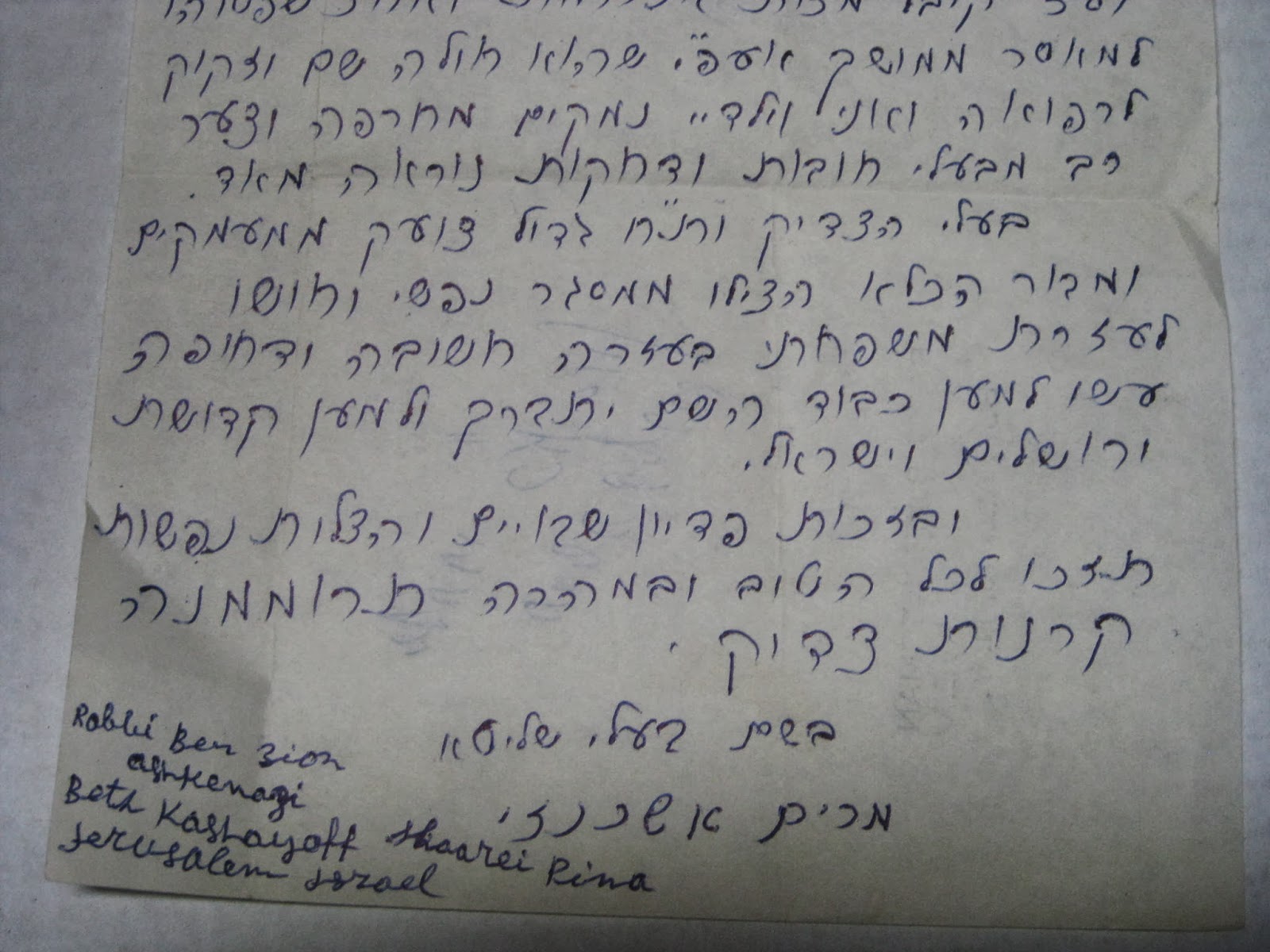
In 1958, one of the largest protests of the Haredim in infant Israel took place, against a proposed public swimming pool that would allow mixed swimming of men and women. The protests did indeed work, and the swimming pool project was eventually called off, but I found a letter which shows some of the unintended causalities of such protests, which persist long after the dust from the protests have settled.

The letter is from the wife of Ben Zion Ashkenazi who was arrested in the protest. His wife describes how now, four months after his arrest, he is ill and lacks medical care, she and her son are are living in shame and sorrow from their many creditors......

The letter is signed and stamped on reverse by a member of the Edah Haharedit, Rabbi Yisrael Yitzchak Halevi Reisman (Otzar Harabbanim 12254) a dayan of of the Eidah, with 4 lines in his handwriting.

The letter is addressed to Rabbi Dov Zuckerman of Buffalo, NY.


Letter concerning a massive protest, against building a "swimming pool with mixed swimming" in Jerusalem the Holy City, signed by the heads of the "Mo'etzet Gedolei HaTorah" in Jerusalem: Rabbi "Zvi Pesach Frank" Rabbi of Jerusalem, Rabbi "Dov Berish Weidenfeld" the Tshebin Rav, Rabbi "Eliezer Yehuda Finkel" Head of Mir Yeshiva, Rabbi "Zalman Sorotzkin" the Rabbi of Lutsk and Rabbi "Akiva Sofer" the Rabbi from Pressburg.

Only in a bookstore: an unusual reason a customer is interested in a book

I have yet to hear of a customer walking in to a clothing store and request a pair of shoes or a cute outfit that he had good memories of as a child. But in a bookstore, this is a daily occurrence, with customers showing much joy in rediscovering a book they have read as a child hundreds of times and often their own children are brought along and forced to share the excitement.

This week, a typical looking Bais Yaakov Girl, with the uniform and all walks in to our store and requests books written by the Hozeh of Lublin. Not a standard reading for today's youth by any means, I innocently asked about the reason for her interest. "He has been appearing to me in my dreams for the last few months and I figured I should read some of his works to find out a bit about him".

Sunday, February 16, 2014

The Practice of Hungarian Schnorrers in America in 1934, described by Yosef Moshe Krumer

 Yosef Moshe Krumer was on of the most curious characters of the Yishuv in Jerusalem, and published several pamphlets in 1934 titled הצופה לבית ישראל prophesying the coming catastrophes to European Jewry and admonishing the Jews for their sins. Rav Kook game him an interesting Haskamah, writing that the author deserves moral support for his intent of bringing the Jews to Judaism.

R. Kook's Haskamah


On pg 6, he describes the practice of the Meshulachim of Kollel Hungariah who traveled to America to collect money. 
"...ומנצלים את שמו הקדוש של החתם סופר. שדרים אלה כשנוסעים לאמירקה הם מקצצים את זקניהם.....ולפני נסיעתם חזרה לירושלים הם מגלים את זקניהם. וכמה הם מרמים את העולם במשך כל ימי חייהם. וכי מי נותן עוד צדקה היום? רק יהודיים עניים..... על מעשה הרמאות של אנשים ידועים מן הכוללים אפשר לכתוב ספרים שלמים"

"They take advantage of the holy name of the Chatam Sofer. These schnorrers, when they leave to America, they cut their beards.. and before their return trip to Jerusalem, they let it grow back. And how much they cheat other people throughout their lives, for who is left today that gives charity, but poor people?..... On the stories of trickery of well-known people of the Kollelim we can write many books...."