One of Western Europe’s largest Hebrew bookstores closed in Amsterdam as its former owners prepare to immigrate to Israel.
Samech, located in southern Amsterdam, has been supplying Hebrew-language books to members of Holland’s Jewish community for nearly 40 years and possessed a stock of 100,000 books, according to the website of the Dutch Israelite Religious Community, or NIK.
The store, which used to be the largest of its kind in the Netherlands, belonged to Daan and Shulamit Daniel, who are planning to move to Israel. All their children had already moved out of the Netherlands in favor of “places with richer Jewish lives than Amsterdam,” according to NIK.
The store’s entire stock was sold or given away last month, the NIK report said. Holland has a Jewish population of 41,000 to 45,000, according to the European Jewish Congress.
Immigration from Western Europe brought 3,243 new arrivals to Israel in 2012, an increase of 6 percent from the previous year. However, immigration from the Benelux area — Belgium, the Netherlands and Luxembourg — dropped that year by 26 percent to 209 new arrivals.
Samech used to service Holland’s outsized population of Israeli expats, estimated by the Dutch Jewish community to be approximately 10,000. (JTA)
Wednesday, August 14, 2013

Monday, August 5, 2013
The Prophecy of Yosef Ibn Yahya: the birth of the state of Israel in the 1940s
Jewish Literature is replete with warnings against calculating the end of days and the coming of Mashiach, but predictions of the era of Mashiach are nearly as common. Some turned out to be more accurate then others, others far off. Here is a lesser known one, which turned out to be surprisingly on the mark, it is found in the commentary of Yosef ben David Ibn Yahya's commentary on the Megillot and Daniel, printed in Bologna in 1538.
Joseph ibn Yahya ben David, was an Italian exegete and philosopher born at Florence 1494 died at Imola 1539. His son was Gedaliah, author of Shalshelet Hakabbalah. He was the author of two works: (1) "Perush" (Bologna, 1538), a commentary on the Five Scrolls and Ketuvim, and (2) "Torah Or" (ib. 1537-38), a treatise on theology and eschatology.
Here is the paragraph from the book where the prediction is made, it appears on page קי in the Bologne edition, in the line that starts with the word באופן
 " באופן כי בסוף החמשת אלפים ושבע מאות שנה לבריאת העולם בקירוב אם מעט אחר כך יבוא קצנו בעזרת ה למען יוכלו לשבת בני ישראל בטח על אדמתם כשלש מאות שנה מהאלף הששי למען יתראה לעין כל היות האמת אתם....."
"In the end of five thousand and seven hundred years from creation (equivalent to the year 1940), or a bit before or a bit after will come the time with the help of god that the nation of Israel may settle securely on their land, for approximately 300 years of the sixth millennium ......."
Now that the author has proven himself with foretelling the future, the second part of his paragraph may not be as eagerly anticipated:
באלף השביעי יהפך העולם לתהו In the Year 6000 (2240 A.D.) the world will transform to emptiness.
Joseph ibn Yahya ben David, was an Italian exegete and philosopher born at Florence 1494 died at Imola 1539. His son was Gedaliah, author of Shalshelet Hakabbalah. He was the author of two works: (1) "Perush" (Bologna, 1538), a commentary on the Five Scrolls and Ketuvim, and (2) "Torah Or" (ib. 1537-38), a treatise on theology and eschatology.
Here is the paragraph from the book where the prediction is made, it appears on page קי in the Bologne edition, in the line that starts with the word באופן

"In the end of five thousand and seven hundred years from creation (equivalent to the year 1940), or a bit before or a bit after will come the time with the help of god that the nation of Israel may settle securely on their land, for approximately 300 years of the sixth millennium ......."
Now that the author has proven himself with foretelling the future, the second part of his paragraph may not be as eagerly anticipated:
באלף השביעי יהפך העולם לתהו In the Year 6000 (2240 A.D.) the world will transform to emptiness.
Tuesday, July 30, 2013
the Stamp of Rachel Citron, daughter of the Rogatchover Gaon
I just came across what for me was a first, a stamp of a Rebbetzin in a book. The stamp is that of the famed Rachel Citron, the daughter of the Rogatchover. Note the English portion of the stamp, Rev. Mrs Rachel Citron. Much has been written about Rev. Mrs Citron, and her devotion to publishing her father's writings. Below is a photo of a book of her husband she published, Rabbi Yisrael Aba Citron's chiddushim. The introduction is signed by Rachel Citron, "in a pained and broken heart" בלב כואב ונשבר.
Her husband's death, childless, left her in a complicated halachik position regarding her halitzah. One of the deceased's two brothers was an apostate in Germany, the second was a communist, inaccessible in Soviet Russia. You can read about the ensuing debate about how to get the halitzah done, in Marc B. Shapiro's Between the Yeshiva World and Modern Orthodoxy, pages 95-96. She never ended up remarrying, and was murdered in the Holocaust.


Shortly after the last envelope was mailed, the Nazis deported the Jews from Dvinsk to Breslau where they were all murdered on June 3rd 1942 and lie together in a mass grave. Rebbetzin Rachel Citron was a childless widow, and Rabbi Yisroel Alter Safern-Fuchs was only thirty years old and unmarried at the time they were murdered. They spent the last five years of their lives (1936-1941) working feverishly to publish the invaluable writings of the Rogatchover and his correspondences from rabbis in all continents[1]
[1] http://www.tzafnat.com/mission--history.html
Monday, July 8, 2013
A bencher from the wedding of Rabbi Nosson Slifkin
.JPG)
If you dig through geniza enough, some interesting things eventually show up.
hat tip: Rabbi Yehuda Ariel Ovadia
Saturday, July 6, 2013
On a descendant of the Chatam Sofer


This week, I had the pleasure of meeting Prof. Moshe Schreiber, a descendant of the Chatam Sofer (and depriving him of his books). In his home, he had Portraits of his illustrous ancestors, the Chatam Sofer, the Ktav Sofer, the Shevet Sofer, followed by a photo of himself with the caption טעות סופר. I got enjoyment out of it, I figured I'd share.
The source for the quip is said to have originated with Rabbi Yehuda Leib Fishman Maimon in reference to Avraham Sofer, the editor of several volumes of the Meiri, from manuscript.
Sunday, June 30, 2013
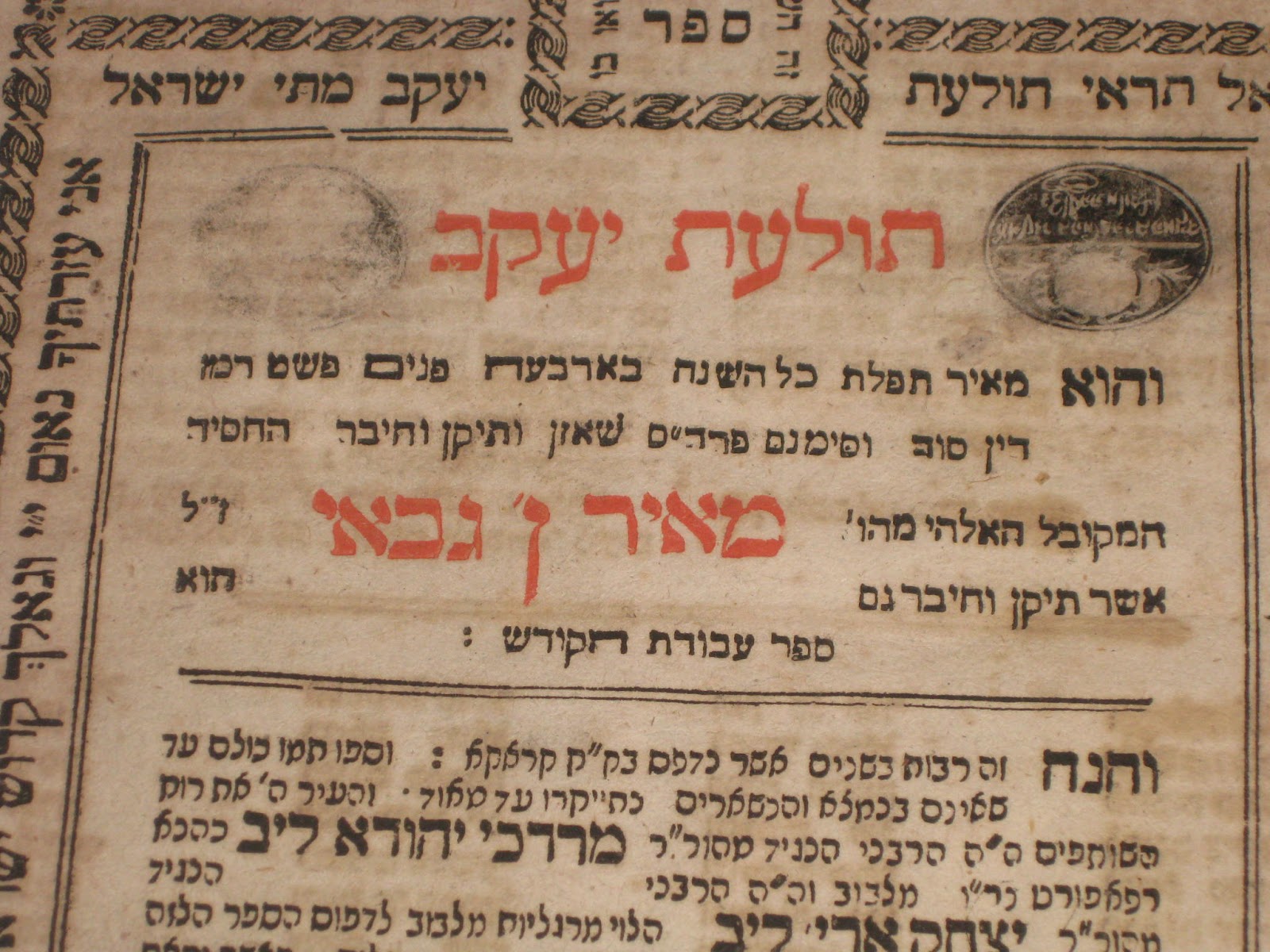
Tolaat Yaakov by R. Meir Ibn Gabai; does the ד in פרד"ס stand for דרש or דין ?
The title page of Tola'at Yaakov throughout the editions, describe the book as a commentary based on פרד"ס


interestingly, the title page does not use the standard פשט, רמז, דרש, סוד rather substituting דרש with דין. I found no record of anyone using this version elsewhere, though I imagine it was used just to make it fit in with פרד"ס as the author did not use Derash.
What's interesting is that the Koenigsberg (1859) edition's publisher changed it to דרש presumably thinking the original edition had it in error.

 |
| THE 1793 ZHOLKVA EDITION |

 |
| THE 1859 KOENSIGSBERG EDITION |
Friday, June 28, 2013
a translation of the Torah to British שפת בריטניה זכה

In 1908 Shapiro and Vallentine published a set of Chumashim, with English translation. The translation is described as שפת בריטניה זכה Pure British. I have never heard English being called such and technically the British Language has been extinct for many centuries. It seems they got a bit overboard with their patriotism here.
Sunday, June 23, 2013
The 1838 Printing of a commentary on Iyov by R. Simhah Arye b. Ephraim Fishel ha-Levi of Hurbisov, and the reason behind it.
R. Simhah Arye of Hurbisov published an extensive commentary on Iyov in 1834 in Lvuv. 4 years later, he reprinted the commentary in Warsaw, 1838. On verso of title page the author states that he still has 800 copies of the first edition which have not been sold, but as the government forbids him to import the books to his current home in Warsaw, he is reprinting them.

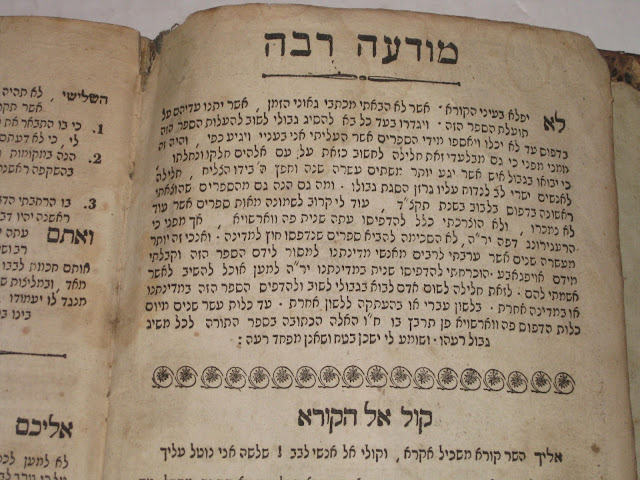


In his introduction the author gives three conditions to anyone who wants to read his work.
1. You are forbidden to read the book unless you have read the introduction in it's entirety.
2. You can not skim through or jump around the commentary, you must read it straight through, as all of the commentary is one continuous message.
3. You must first make sure to understand the translation of the Biblical text before reading the commentary.

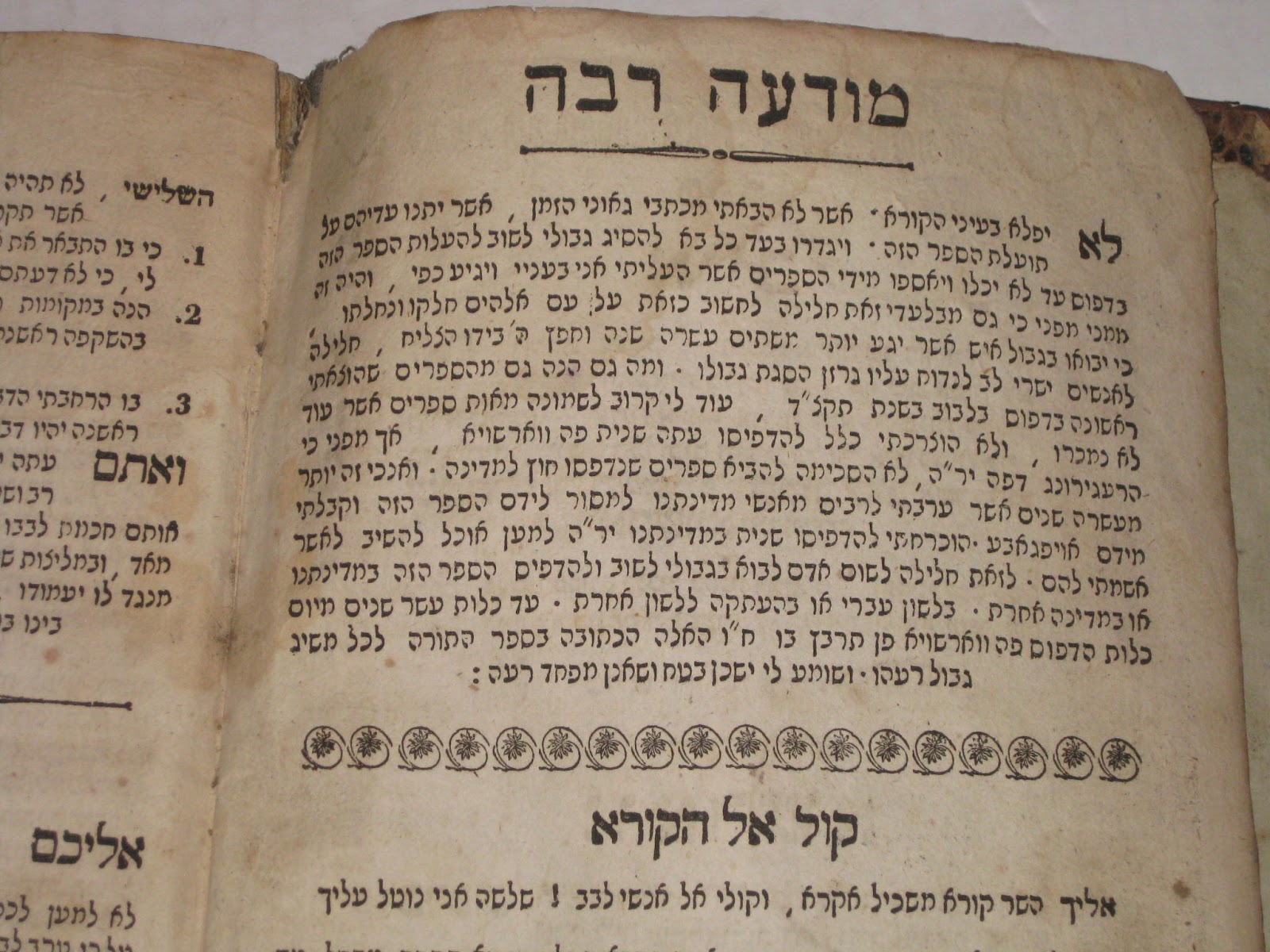


In his introduction the author gives three conditions to anyone who wants to read his work.
1. You are forbidden to read the book unless you have read the introduction in it's entirety.
2. You can not skim through or jump around the commentary, you must read it straight through, as all of the commentary is one continuous message.
3. You must first make sure to understand the translation of the Biblical text before reading the commentary.
Monday, June 17, 2013
Interesting Statement printed at end of the book Nes Pach Hashemen נס פך השמן 1893


At end of book is a curious statement: seen in the photo above, with the author talking to his book, telling him how (loosely translated) "the world is full of gangsters and enemies of the religion, but he shall not fear to go out alone because we have many with us... and you shall fight the anti-miracle Jews, and then the light of faith shall shine.."
Sunday, June 16, 2013
Gangster Heaven

This photo was taken in the Bialystoker Synagogue's, New York rear wall memorial plaque. Bugsy Siegel and his father Max are memorialized right next to one another
On the plaques above see the name Max Siegel, Bugsy Siegel's father, whose Hebrew name is "Mordechai Dov B"R ['Ben Reb', son of Mister] Beirush HaLevi" (from the Hebraic tribe of the Levites) and the one for Bugsy whose Hebrew name is "Bairush HaLevi B"R Mordechai Dov HaLevi"; implying that Bugsy was named after his grandfather who predeceased his birth.
I wonder how much was paid for the plaque just following Siegel's, knowing how much Jews care about good neighbors in death, not much I suppose.
Subscribe to:
Posts (Atom)