
Tuesday, February 23, 2016
An inscription from Rav Tzair ( Chaim Tchernowitz) to Rabbi Henry Pereira Mendes
I came across a copy of a book inscribed by Rav Tzair ( Chaim Tchernowitz) to Rabbi Henry Pereira Mendes. Interestingly, the inscription is in block Hebrew letters, apparently as Mendes would not have been able to read the Ashkenazi Hebrew script that Rav Tzair generally used. Mendes died shortly after this inscription aged 85.


Reading material to be found in a Jewish restaurant in Bucharest
A set of Chok Leyisrael, printed in Lemberg in 1899 which I recently acquired, had numerous stamps of
"GUSER GROSSMANN RESTAURANT AND BODEGA, BUCHAREST".
You can envision a group of saintly elderly Jews, coming in for their daily coffee at a set hour every morning, and reading along the daily portion of the Chok LeYisrael, while the youngsters in the room are sitting with their daily newspapers.


"GUSER GROSSMANN RESTAURANT AND BODEGA, BUCHAREST".
You can envision a group of saintly elderly Jews, coming in for their daily coffee at a set hour every morning, and reading along the daily portion of the Chok LeYisrael, while the youngsters in the room are sitting with their daily newspapers.


Public notice: looking for Prof. Yehudah Mirsky's copy of Eyn Ayah
A request from Prof. Mirsky: "Three
years ago, I shipped a box of books from Israel to the US, which
included a set of Rav Kook's Eyn Yaacov commentary, Eyn Ayah, with many
notes that I'd put in it over several years of intensive study. Sadly,
that box was lost. The mailing label came to the US address, with
nothing more."
If anyone should ever come across his books, please be kind enough to contact Prof. Mirsky at mirsky - at - brandeis - dot - edu.
If anyone should ever come across his books, please be kind enough to contact Prof. Mirsky at mirsky - at - brandeis - dot - edu.
Monday, October 12, 2015
METZITZAH B'PEH and the response of Moroccan Rabbis תקנות מועצת הרבנים במרוקו בענין מציצה בפה
In 1952 (סיון תשי"ב), the annual conference of Moroccan Rabbis took place in Rabat, with nearly all the leading Rabbis of the day attending. Attendees included Rabbi Shaul Ibn Danan, R. Refael Baruch Toledano, R. Machlouf Abuhetzera, R. David Ovadia, R. Yehoshua Maman, R. Yedidya Monsenego, R. Ahron Hasin and many other familiar names. Many issues of the day were discussed and many new enactments were agreed upon and imposed. Buried between the decisions reached I came across a replica of the scenario which has been unfolding in recent years on the issue of metzitzah b'peh or MBP as it has come to be referred to, with strikingly different responses.

Here is the text of the Takanot regarding MBP that were unanimously agreed upon by all participating Rabbis:
loosely translates as:
My Rabbis ! Our holy Torah has strongly warned us, thou shall be very careful with your souls, obligating us to protect our bodies that no harm shall befall it from any harmful possibilities by nature, and even in regards to our Mitzvoth, the Torah says, you shall do them and live through their doing.
It is thus our obligation to involve ourselves with such matters, even in these days.
The commandment to circumcise our children is of the fundamentals of our faith, and needs to be done purely, with no flaws, which includes no imperfections in the matters of health.
It is thus incumbent on all Mohalim to familiarize themselves with all the laws of circumcision and hygiene in all his work.
This work also has to be supervised by a body that will supervise all the Mohalim in all matters, and we shall not leave the children of the Jews to be like fish and leave their fate in the hands of any man who possesses a chisel.
There is no need for me to mention the unfortunate disasters that occurred due to Mohalim who were not experts or not done under sanitary conditions, as it is of no use, the main thing is to perfect and correct for the future. On the past we confess and request that God forgives us..
I thus request from you esteemed Rabbis, to agree on the following conditions and that they find favor in your eyes:
1. Any Mohel, including present ones, need to receive a certification from a doctor that confirms that he has no infectious illness, this certification shall be renewed yearly.
2. The Mohel is required to take lessons on the methods of hygiene, both in his hands and in his vessels, as well as any medical issues that may arise after a circumcision
3. The Mohel shall receive his training in any public hospital
4. It is the obligation of the Mohel to use the knowledge obtained during these lessons
5. The Mohel needs to be trained in the Halachot relating to Milah as well, from the local Rabbinical Court
6. The Mohel is obligated to visit the infant before as well as after the circumcision
7. Every Mohel needs to receive certification from an accepted and well-known Mohel
8. The Mohalim in every city shall gather and appoint one of the Mohalim to head and inspect the Mohalim in his district
9. If a Mohel does not work for 2 years, he needs to be retrained
10. One who is ill, with poor eyesight or with trembling hands, can not perform a Milah
11. Metzitah shall be with a vessel and not done with the mouth
12. Any Mohel who does not perform metzitzah shall be removed from his position
13. Trained Mohalim are encouraged to train new Mohalim
14. Students learning Milah can perform with a certified Mohel present
15. The ultimate authority regarding certification etc is in the hands of the local Rabbinical Court.
16, All registered and certified Mohalim shall be listed at the Bet Din and the list made common knowledge
17. All utensils used in the Milah shall come from the community funds.
All the above was unanimously agreed upon by all.
This same year many other important enactments were enacted, including equating both sexes in all laws of inheritance, including married women. This issue evoked a sharp differing response from the Israeli Rabbinate. The Beginning of the publication also describes the dire situation regarding the lack of available books in Morocco, and the many organizations that have attempted to assist them in this matter. You can read this section in full below:

 |
| List of decisions by the Rabbinical Assembly |
 |
| List of participating Rabbis from all major cities and geographical areas of Morocco |
Here is the text of the Takanot regarding MBP that were unanimously agreed upon by all participating Rabbis:
רבותי! תורתנו הקדושה הזהירה באזהרה חזקה ונשמרתם מאד לנפשותיכם. בא הכתוב לחייב את האדם בשמירת הגויה לבל לאונה כל רע מגרם הנזקין המצויים בתולדות הטבע. וגם במצוותיה אמרה תורה אשר יעשה אותם האדם וחי בהם
בכן חובתינו להתעסק בענינים כאלה ומה גם בזמננו זה
המצוה הגדולה מיסודי הדת היא המילה שצריכה להיות טהורה מאף שמץ לא טוב. ז"א ככל חוקות משפטה ובכל אופן טהרה של שמירת הבריאות
על כן צריך שהמוהל יהיה בקי בדיני המילה וטהור בכל משמרת עבודתו
גם עבודה זו הקדושה והטהורה צריכה להיות תחת השגחה עליונה המפקחת על המוהלים בכל הענין ולא יהיה ילדי ישראל כדגי הים נתונים ביד כל אוחז איזמיל
ואין אני צריך להזכיר לפני רו"מ המאורעות הרעים אשר קרו על ידי המוהלים אשר לא מומחים וגם על ידי אי נקיות כי אין בזה שום תועלת רק העיקר הוא להשגיח ולתקן בהעתיד. ועל העבר אנו מתודים ואומרים כפר לעמך ישראל אשר פדית ה והקב"ה הבטיחנו ונכפר להם הדם
על כן אני דורש מכת"ר הסכמה על הפרטים שנזכיר הלאה אם נראו בעיני רבותי:
א. כל מוהל אף הנוכחים צריך לקבל תעודת רופא המאשרת שאין בו כל חולי המתדבק ומידי שנה בשנה תהיה בדיקה זו
ב. גם חובתו לקבל שיעורים באופני הנקיות לכל צרכי המילה בין בנקיון ידיו בין בכיליו בין בידיעת שמירת כל הנזקים הנמשכים גם אחר המילה
ג. למוד ידיעתו זאת והרגלו יהיה לו בחברת אוזי או בבית חולים צבורי
ד. חובתו להשתמש בידיעותיו אלה כאשר ישיתו עליו הרופאים הנזכרים
ה. גם צריך לקבל ידיעה בדיני המילה בתעודה מאת ביה"ד המחוזי
ו. המוהל צריך שיבקר את הילד קודם המולו וגם אחרי כן
ז. המוהל צריך לקבל תעודה מאת מוהל מומחה מפורסם
ח. המוהלים שבעיר יערכו אסיפה באולם ביה"ד או הדומ"ץ וימנו את המומחה שיהיה בהסכמת בראב"ד או הדומ"צ
ט. כל מוהל שהפסיק מעבודתו שתי שנים רצופות צריך תעודה חדשה
י. חולה חלוש הראיה או מרתת לא יכול למול
יא. המציצה תהיה בכלי ולא בפה
יב. כל מוהל שלא עשה המציצה מעבירים אותו
יג. המוהלים המוסמכים אל ימנעו עצמם מללמד אחרים כדי שיאמר עליהם זכר צדיק לברכה
יד. המתחנך יכול למול לפני המוסמך בהשגחתו עליו
טו. ההשגחה העליונה על המוהלים בדבר התעודות ובדבר הנקיות ובשמירת כל החוקים חובתה על ביה"ד או הדיין חבר העיר
טז. המוהלים המוסמכים שקבלו תעודותיהם לכל עניני המילה ככל האמור יהיו רשומים בב"ד ובבתי כנסיות להודיע לכל העם
יז. המכשירים לכל צרכי המילה וכל ההוצאות הצריכות יהיו מקופת הקהלה
הכל נתקבל בהסכמה
loosely translates as:
My Rabbis ! Our holy Torah has strongly warned us, thou shall be very careful with your souls, obligating us to protect our bodies that no harm shall befall it from any harmful possibilities by nature, and even in regards to our Mitzvoth, the Torah says, you shall do them and live through their doing.
It is thus our obligation to involve ourselves with such matters, even in these days.
The commandment to circumcise our children is of the fundamentals of our faith, and needs to be done purely, with no flaws, which includes no imperfections in the matters of health.
It is thus incumbent on all Mohalim to familiarize themselves with all the laws of circumcision and hygiene in all his work.
This work also has to be supervised by a body that will supervise all the Mohalim in all matters, and we shall not leave the children of the Jews to be like fish and leave their fate in the hands of any man who possesses a chisel.
There is no need for me to mention the unfortunate disasters that occurred due to Mohalim who were not experts or not done under sanitary conditions, as it is of no use, the main thing is to perfect and correct for the future. On the past we confess and request that God forgives us..
I thus request from you esteemed Rabbis, to agree on the following conditions and that they find favor in your eyes:
1. Any Mohel, including present ones, need to receive a certification from a doctor that confirms that he has no infectious illness, this certification shall be renewed yearly.
2. The Mohel is required to take lessons on the methods of hygiene, both in his hands and in his vessels, as well as any medical issues that may arise after a circumcision
3. The Mohel shall receive his training in any public hospital
4. It is the obligation of the Mohel to use the knowledge obtained during these lessons
5. The Mohel needs to be trained in the Halachot relating to Milah as well, from the local Rabbinical Court
6. The Mohel is obligated to visit the infant before as well as after the circumcision
7. Every Mohel needs to receive certification from an accepted and well-known Mohel
8. The Mohalim in every city shall gather and appoint one of the Mohalim to head and inspect the Mohalim in his district
9. If a Mohel does not work for 2 years, he needs to be retrained
10. One who is ill, with poor eyesight or with trembling hands, can not perform a Milah
11. Metzitah shall be with a vessel and not done with the mouth
12. Any Mohel who does not perform metzitzah shall be removed from his position
13. Trained Mohalim are encouraged to train new Mohalim
14. Students learning Milah can perform with a certified Mohel present
15. The ultimate authority regarding certification etc is in the hands of the local Rabbinical Court.
16, All registered and certified Mohalim shall be listed at the Bet Din and the list made common knowledge
17. All utensils used in the Milah shall come from the community funds.
All the above was unanimously agreed upon by all.
 |
| discussion and Takanot regarding MBP |
 |
| discussion and Takanot regarding MBP |
 |
| Magen Avot of Rabbi Levhar regarding the position of Moroccan Rabbis to Metzitzah B'peh |
 |
| Magen Avot of Rabbi Levhar regarding the position of Moroccan Rabbis to Metzitzah B'peh |
This same year many other important enactments were enacted, including equating both sexes in all laws of inheritance, including married women. This issue evoked a sharp differing response from the Israeli Rabbinate. The Beginning of the publication also describes the dire situation regarding the lack of available books in Morocco, and the many organizations that have attempted to assist them in this matter. You can read this section in full below:
 |
| On the inability to find Hebrew books in Morocco |
 |
| On the inability to find Hebrew books in Morocco |
R. SY Zevin, R. Nissan Waxman, Sefarim Criticism & More
by Jacob D.
One of the unique roles that R. Shlomo Yosef Zevin filled with his prolific pen was that of a sefarim critic par excellence. A new Torah publication hits bookstore shelves and there's a good chance that it will be thoroughly reviewed, analyzed, criticized or praised, by a Torah giant with a mind of encyclopedic breadth, in an upcoming Friday morning Hatzofe. R. Zevin took his "מן הספרות התלמודית" column seriously, and week after week Hatzofe readers can expect a new thorough and exciting Zevin review. Most of these reviews were eventually collected and published in his three volume סופרים וספרים (Tel Aviv, 1959). Even in the most positive of reviews on works that he seems impressed with, we can expect the occasional -
...ויש להעיר שכבר קדמו בזה...
With that small introduction I would like to share something I just came across, which to me was a little bit of a surprise. During a recent stop at a used Hebrew bookstore, a small attractive copy of R. Moshe Cordovero's תומר דבורה caught my eye -


It's a critical edition published in NY,1960 (5720) by R. Nissan Waxman.
(see here)

On the title page we see that aside for the actual work by Ramak, and what's directly related to it (notes, a biographical sketch of the author, etc.), there's an additional section appended at the end, titled קונטרס האהבה והחסד. In one part of that last section R. Waxman relates an explanation of a Midrash about עקידת יצחק in the name of R. Hayim Soloveitchik of Brisk -


At the end of the piece we read that R. Waxman heard this from R. Menahem Krakowski, a Rabbi from Vilna and student of R. Hayim. R. Krakowski published this piece of his teacher's Torah in his ארזי לבנון -

See starting from the second to last paragraph of this page-


R. Waxman notes that this explanation from R. Hayim is also related by R. Zevin in his אישים ושיטות, and in his "העקידה" essay in his לאור ההלכה.
In לאור ההלכה -

W. adds that although Z. includes some additional halakhic material at the beginning of this piece that R. Krakowski didn't relate, he leaves out this last point -

which in R. Waxman's words is quote "לב הדבר ויפיו"! -

I'm not used to R. Zevin being on the receiving end of this kind of criticism. (I also found it kind of ironic that this "לב הדבר ויפיו" that W. felt Z. should've included sounds very much like a R. Levi Yitzchak of Berditchev classic. Z. the Hasid (also the author of סיפורי חסידים) doesn't include it, but does include some additional halakhic material. And W. the Litvak is complaining!)
In R. Zevin's defense I will say that his אישים ושיטות wasn't written to simply share the Torah of the ten great אישים that are discussed therein. It was written to dissect and define their very specific and distinct Torah methodology. Hence, this omission, which if included wouldn't anyhow help to define R. Hayim's method of study is perfectly sound (of course I do entertain the possibility that this part wasn't known altogether to R. Zevin). And this aggadic twist wouldn't exactly belong in his לאור ההלכה either. In לאור ההלכה R. Zevin begins this R. Hayim Torah with -
גוון הלכתי מיוחד להעקדה נתן רב חיים סולוביצ'יק ז"ל יחד עם מדה עקרונית בדרכי הלימוד
An addition of this sort, as beautiful as it may be, would hardly belong there. It does fit nicely in R. Waxman's addendum to a mussar work, and likewise, it's totally befitting for this aggadic "לב הדבר ויפיו" to be included in R. Krakowski's קובץ דרשות.
Marginalia on the side of Hebrew Books in Arabic הגהות על ספר קדש בערבית


I recently came across what for me was a first, a Hebrew book, being the poems of Yehuda Alharizi, printed in Vienna in 1854, with marginalia in Arabic.
There is a title page in Hebrew and one in German as well. There are several stamps in the book of Rabbi Yaakov Attieh, who served as Chief Rabbi in Beirut, as well as the signature of Eliyahu Hai Sasson, the founder of the first Hebrew printing press in Syria, founded in 1865. Along with numerous marginalia in Hebrew, appear a few lengthy ones in Arabic.


Recent Acquisition: the Library of Rabbi Michael L. Abraham
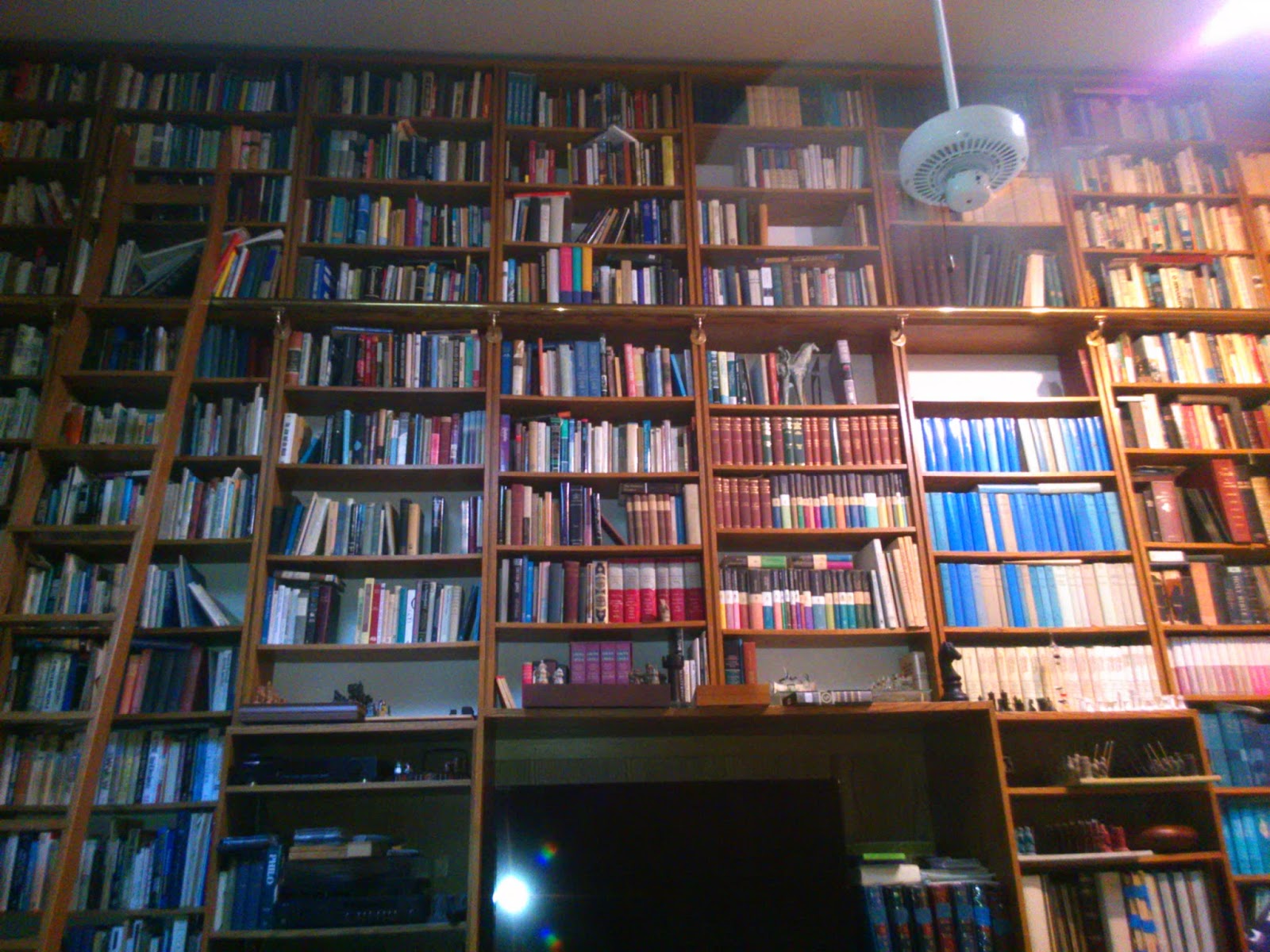 |
| partial view of Rabbi Michael L. Abraham's library |
Mizrahi Bookstore has recently acquired the collection of Rabbi Michael L. Abraham. Rabbi Abraham, after graduating from HUC served congregations in Blue Pell, PA, Norwalk Conn, Sommerville, NJ as well as "Chief Rabbi of New Zealand", where he served as Senior Rabbi of Temple Sinai in Wellington for six years. He passed away on Dec 14, 2013 aged 75.
Rabbi Abraham was that rare combination of a scholar and an active and successful pulpit Rabbi. His comprehensive library traveled with him throughout his life, with his library at the time being the largest Judaic Library in New Zealand. Nearly all important books on Bible Studies and Archaeology were present in his library, and nearly all with relevant book reviews inserted and with his marginalia and remarks alongside in his neat pencil writing. Every one of his books was fully cataloged and shelved systematically, many a public library would envy his perfect order in his books. תהי נשמתה צרורה בצרור החיים
Monday, August 17, 2015
The Drastic Changes now in effect at The Library of the Jewish Theological Seminary and its effect on future scholarship
 |
| courtyard of JTS Library soon to be demolished |
JTS, which has been faced with financial troubles in the past years, has attempted various different ways in the last years to solve their financial woes. In 2009, a major change in the leadership positions occurred, and several months ago, several of the JTS Library's rare items not related to Judaism have been sold at auction in an attempt to raise funds.
The current plan for the next few years (at least through the end of 2018) leaves just 10,000 volumes in the library until construction is completed. Once the new library building is in use, the plan is to keep about 25 percent of the titles onsite in the new Library. The remaining 75 percent will be stored offsite, available only for next business day retrieval. The temporary home, will open November 1 and will be located on the 7th floor (both Kripke and Schiff buildings, formerly the student computer and language labs) for the duration of the project. Those people who do not currently have borrowing privileges, which include the numerous researchers who visit and use the library, will be charged a fee equivalent to their cost (between $3.25 and $8.75 per item) for retrieving materials from their remote storage. The Library reserves the right to limit quantities of all materials retrieved from remote storage based upon consultations with the researcher.
To summarize, the library, which for over a century was the base from which some of the very best scholarship and printed works emanated, will for posterity be at best a very inconvenient and costly place to do research. The numerous publishers and editors of books, that for decades have relied on the fabulous collection of the library will now have to work with their hands tied and their pockets emptied. A scholar with a table full of books being referenced, can be charged for their use the price of a 5 course meal in a Manhattan restaurant. Seeing references in a footnote, a scholar can no longer request the book and check relevant sources, he would need to place a request and return an additional day to be able to view it in person. Rather than encourage students and scholars to explore the world of our history and literature, people will have to contemplate the cost of obtaining the book for reading and come back the following business day to obtain it. Books requested on Thursday afternoons, will not arrive in the library until Tuesday.
To be fair, JTS may have been left with little choice as to this decision, and for their rabbinical students, such a system at the library might suffice. I assume this was the very last resort that the administration was left with, but the thought of the largest collection of Hebrew Incunabula sitting in a warehouse in NJ, is disheartening at the very best. It is rather depressing to think, that as a people who excelled at coming together and succeeding in fundraising for our vital institutions, that the nation's most prestigious Jewish library should be forced to come to this. Throughout the World of Jewish Books, the future of the library has been received with much sadness and anger. In the words of Prof. Shnayer Leiman, "Very sad news about JTS! Let people know that there is nothing safer than having the books in their own house". Prof. Leiman recalled his days of youth when his ability to roam stacks of endless books allowed him to develop his interests. With the setup as is projected, students will never be introduced to the vast depths of Jewish Literature and the books will more than likely be stored into oblivion. In a conversation I had with one of the librarians at JTS, she tells me how it doesn't matter much, as "who today uses books anyways!".
It is very unfortunate that JTS no longer will be able to view its library as a home for all Jews of all backgrounds and denominations. The best we can do is hope that a change can still be made and the freedom of the printed word will be reimposed.
Yosef Goldman - Jewish Book Dealer 1942 - 2015
Yosef Goldman, a veteran Jewish/Hebrew bookseller, passed away on Aug. 4, 2015. Born in Neipest, in 1942, where his father, Rabbi Chananya Yom Tov Lipa Goldman (1907 – 1980) was Rabbi, and where the family survived most of WWII disguised as non-Jews. In 1950, the family immigrated to the United States, his father having a synagogue in the Crown Heights neighborhood of Brooklyn and where he operated a publishing house. Yosef attended Beth Medrash Elyon, in Monsey, NY.
Y. Goldman was the authoritative dealer on American Jewish Printings, and the 2 volume Hebrew Printing in America, 1735-1926, A History and Annotated Bibliography, which he co-authored and which was based on his collection is the standard reference in the field. Many prominent American Judaica collections were built through his guidance and expertise.
Yosef is remembered as an erudite scholar, kindhearted and giving when it came to charity, well versed and a passionate lover of Eretz Yisrael, where he chose to be buried. He passed away on Aug. 4 after a brief illness.
Y. Goldman was the authoritative dealer on American Jewish Printings, and the 2 volume Hebrew Printing in America, 1735-1926, A History and Annotated Bibliography, which he co-authored and which was based on his collection is the standard reference in the field. Many prominent American Judaica collections were built through his guidance and expertise.
Yosef is remembered as an erudite scholar, kindhearted and giving when it came to charity, well versed and a passionate lover of Eretz Yisrael, where he chose to be buried. He passed away on Aug. 4 after a brief illness.
Reminiscences of Rabbi Joseph Samuel Bloch penned by Charles Duschinsky in a copy of his Reminiscences
In the free-end of Charles Duschinsky's ( Jewish Historian 1878–1944) copy of My Reminiscences by Dr Joseph Samuel Bloch, appears a lengthy interesting handwritten entry as follows:


hat-tip: Yitzchak Stroh


Nov
1929
[Received],
from Dr. Grunwald, Rabbi in Vienna, and son-in-law of the late Dr. J.S. Bloch.
The latter was a great friend of my Uncle Oberrabbiner Wilhelm Reich ז"ל of Baden bei Wien, who died on 17th
of Tammuz 5689-1929. When my uncle visited me a few years ago, just after the
death of Dr. Bloch, he told me that B. was running about from library to
library with books under his arm working on his last two books, The story of
his life “My Reminiscences” and Israel u. die Volker (also translated “Israel
and the Nations”). “That,” he said, “probably killed him”. He (my uncle), being
then just over 70, said, that at that time in life things must be taken
leisurely. He would like to write more books, “but it’s no use killing
yourself”. Nevertheless he died “killing himself”. The heat last July in Vienna
was very terrible, and on the 16th of Tammuz he attended a funeral
where he delivered a “Hesped” (funeral oration). As he bent down afterwards to
throw the first earth upon the coffin, he collapsed either from a sun-stroke or
heart failure and never recovered consciousness. He died the same night at the
age of 76. – I can for myself, truly say: deeply mourned. זכר צדיק
לברכה
C.
D.
24/11/29
Dr.
Bloch was a great friend of mine. – He encouraged me when I was a very young
man, and printed articles & notes from me, while I was still at Pressburgh
in the Yeshivah, and I was a constant contributor to his “Oesterreichisthe
Wochenschrift” even while in London right till the outbreak of the war in 1914.
– A clever and learned man, very jovial and friendly. He was, at one time, a
great power in the Vienna Jewish community. As a journalist he was not liked by
everybody, but he had a great following. It was through his influence that his
son-in-law Dr. Grunwald was elected Rabbi in Vienna. There are a good many
bon-mots still in circulation from & about him.
C. D.
hat-tip: Yitzchak Stroh
Subscribe to:
Comments (Atom)