
Sunday, December 23, 2012
a Case of Jewish Murder in Germany in the 15th Century
Murder of a Jew by a Jew was an extremely rare occurrence during the Middle Ages, here is a mention of one I found, with the case brought before Rabbi Israel Bruna (1400–1480). See his Responsa Siman 265 below.


Superstitions in 17th Century Poland: Tobias Hakohen's remark
Tobias ben Moses Cohn (1652–1729) in his "medical" book Ma'aseh Tuviah, makes this interesting remark in reference to the country of Poland. " There is no country in the world, where people occupy themselves with demons, amulets, incantations, conjurations, and dreams more than in this country" He notes, that even if there were no such things as demons, they should have been created for the sake of this country.
 |
| Maaseh Tuvia, Yesnitz 1721, page 86c |
Tuesday, December 18, 2012
Can you steal Manuscripts so you can copy them? a responsa of the Ri"f

Here is an interesting Responsa of the Ri"f : Question: one of the students stole books of commentaries from his friend and when asked to return them, he swore that he will not return them until he is allowed to copy them, and there was a Rabbi who permitted stealing them for this cause, what is the Halacha?
Teshuva: The thief and the one who permitted it were both wrong. The Ri"f goes on to say that the thief transgressed 3 commandments of the Torah.
Immanuel di Romi and his stealing of books
Here is an account of the ways Immanuel di Romi in the 13th century got his books to read and his response when getting caught. Quoted from the Jewish Quarterly Review vol 4, page 76


Monday, December 17, 2012
Please look out for this book stolen from our store


|
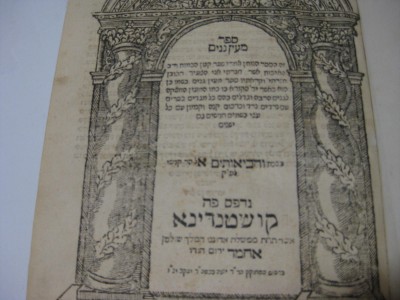
|
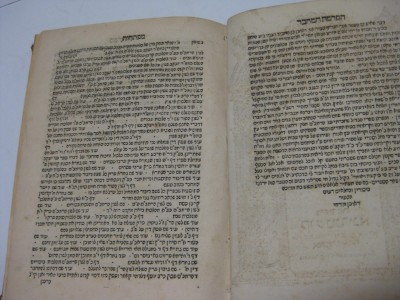
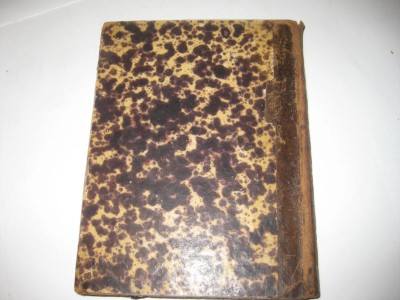
Saturday, December 15, 2012
A burnt book as the source of an Ashkenazi Minhag for Chanukah
The Havot Yair of Yair Chayim Bacharach brings down a fascinating source for a certain custom of the community of Worms came about (Havot Yair siman 238): Once when speaking with a scholar in Worms, he expressed his wonder at the minhag in vogue there of commencing the recital of the Meorah on the Sabbath of Hannukah with the middle of the Piyut, and was informed that this custom was based on the following event. During one of the persecuations, all the existing handwritten prayer-books were destroyed, and when after the persecution the reorganization of the community began, only one prayerbook was found, in which unfortunately the first part of the Meorah for the Sabbath of Hannukah was missing. Because of this, the Jews in Worms had to content themselves with the recital of the second part of the piyyut only. From then onwards, this became a general custom, although books containing the whole text were available.
Here is the text of the original Teshuvah:
אף כי לדעתי מנהג אמירתם בקהילות ישנות
באשכנז אין ראיה מכרחת שנעשה בהסכמת חכמי הקהילה או הדור כ׳ כמה מנהגים כאן
מהמון עם אחר גזרות תתכ׳ו וק״ט ששלוכי השמד חזרו ונתישבו מתי מספר ונהגו
לפי ידיעתם ורצונם ונקבע אח"כ למנהג בלי משים על לב
ובימי
חרפי היה לי פתחון פה עם זקן אחד בעל תורה ודיין בק״ק ווירמ״שא ועל
שתמהתי מאד על מנהג זר שמתחילן מאורה לשבת חנוכה ממלכה ממושכה והוא באמצע
הפיוט כ׳ התחלתו שני זיתים וכו והישיבני כי שמע מפי זקני גדולי הקהילה כי
בשעת הגזירות נשרפו כל סררי תפילות ומחזורים
וכאשר
לא היה נמצא הדפוס היה מחזור א׳ וסידורים מעריבי' ויוצרות א׳ לקהל או
למשפחהזמן רב אחר שעבר זעם שחזרו ונתיישבו מתי מספר אמרו מה שמצאו מפיוטים
שנשאר וכאשר מצאו מאורה הנ״ל רק חציה כאור מוצל מאש אמרו רק חציה שלא לבטל
המנהג לפי שעה ונקכע אח״כ למנהג קבוע
כי הנלפע״ד כתבתי ־ נאם הטרוד יח״ב
Friday, December 14, 2012
Mountain Jews יהודי ההרים and Bircat Shehecheyanu on a New Harvest
At times, a good way to find the customs of Jews 2000 years ago is to compare it with the customs of old isolated Jewish Communities in the world. One such community if that of the Mountain Jews which have been living in their remote towns since at least the 5th century. In 1884 in St Petersburg, יוסף יהודה הלוי טשארני Yosef Yehuda Charney published his book of travels and correspondence with the Mountain Jews. The natives, describe their customs and beliefs and one such custom which I had not seen elsewhere was that of making the Blessing Shehecheyanu on the new harvest.


There seems to be no source for such a custom, other than the blessing that was made in Eretz Yisrael on the harvest while separating the Ma'asrot. Perhaps the Jews who emigrated from Eretz Yisrael towards the Caucasus kept the custom of making Shehecheyanu not realizing the reason no longer applied.
There is much discussion in the Poksim today if to make a Blessing of Shehecheyanu when tithing today. The story goes, that when the Imrei Emes visited Israel, he met with Rav Kook and mentioned that he will be making the Mitzvah of separating the Ma'asrot for the first time, if so Rav Kook said, you can make Shehecheyanu as well. After a heated debate in which the Imrei Emes siding with the opinion of those who do not make Shehecheyanu, he got up and said, if the Rabbi of Jerusalem, was Posek that you do make a Beracha, I accept his authority and did indeed make Shehecheyanu.
Another possibility might be that the blessing they made was an extension of the Shehecheyanu made on purchasing a new home, clothing etc which they extended to be any happy occasion. There seems to be a consensus though with the Poskim that on eating a new vegetable or other non-fruit that Shehecheyanu does not apply (BaCH OH 235).


There is much discussion in the Poksim today if to make a Blessing of Shehecheyanu when tithing today. The story goes, that when the Imrei Emes visited Israel, he met with Rav Kook and mentioned that he will be making the Mitzvah of separating the Ma'asrot for the first time, if so Rav Kook said, you can make Shehecheyanu as well. After a heated debate in which the Imrei Emes siding with the opinion of those who do not make Shehecheyanu, he got up and said, if the Rabbi of Jerusalem, was Posek that you do make a Beracha, I accept his authority and did indeed make Shehecheyanu.
Another possibility might be that the blessing they made was an extension of the Shehecheyanu made on purchasing a new home, clothing etc which they extended to be any happy occasion. There seems to be a consensus though with the Poskim that on eating a new vegetable or other non-fruit that Shehecheyanu does not apply (BaCH OH 235).
Thursday, December 13, 2012
A description of the Jewish Community in Salonica, January 29, 1921

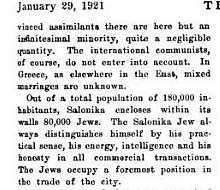
I stumbled across this great description of the now gone community of Salonica, Greece, published in the Reform Advocate, January 29, 1921. It is interesting to note that the article states that mixed marriages are unknown, though anti-semitism was non-existent. Apparently, the lack of Antisemitism in the city, didn't prevent 98% ! of the Jewish Community of Salonica from dying in the Holocaust.
Saturday, December 1, 2012
An outsider teaches me what is wrong with our society
Sometimes it takes someone from the outside to point out our problems to us. I received this email from a customer, and was left at a loss as to what to answer him.
"My children have auto immune issues so I had my DNA tested. Although I was raised as a Christian I have loved Hebrew and the"Old Testament" since my early 20s when I took a Hebrew class at college- it just came natural. I even ate virtually 100% Kosher, went to Synagogue and studied Torah on my own. My DNA came back with a stunning amount of Jewish markers-mostly Ashkenazi and eastern Europe/Western 'Russia'. However there is some Sephardic and Mizrochi. I was relating this to a Jewish friend and received a very odd comment at the Revelation of the Sephardic but especially Mizrochi. Why is this a problem? Why would someone who is observant look down on Mizrochi?"
Though much less prevalent in the diaspora than in Israel, it is odd, that just when we have our own homeland, and our enemies are less out in the open, we choose to quarrel between ourselves. May G-d protect us from ourselves.
"My children have auto immune issues so I had my DNA tested. Although I was raised as a Christian I have loved Hebrew and the"Old Testament" since my early 20s when I took a Hebrew class at college- it just came natural. I even ate virtually 100% Kosher, went to Synagogue and studied Torah on my own. My DNA came back with a stunning amount of Jewish markers-mostly Ashkenazi and eastern Europe/Western 'Russia'. However there is some Sephardic and Mizrochi. I was relating this to a Jewish friend and received a very odd comment at the Revelation of the Sephardic but especially Mizrochi. Why is this a problem? Why would someone who is observant look down on Mizrochi?"
Though much less prevalent in the diaspora than in Israel, it is odd, that just when we have our own homeland, and our enemies are less out in the open, we choose to quarrel between ourselves. May G-d protect us from ourselves.
Wednesday, November 28, 2012
Adas Israel, Fall River, Massachusetts, 1893-2012 an end of an era


 |
| THE EXTERIOR OF CONGREGATION ADAS ISRAEL, FALL RIVER MASS. |
If you Drive by today the magnificent structure of Adas Israel, you will no longer see a Magen David on the door, it is now owned by a church. A long and fascinating history has finally come to its end, the last standing Orthodox Synagogue in Southeastern Mass. has closed its doors. Founded in 1893 in the downtown area of the town, which now has a population of 90,000, this massive building was inaugurated in 1959, in the best part of town.
In the early 1900s, Fall River was a textile industry center, and the majority of the factory owners were Jews who hailed from NY. At one time there were 5 Orthodox synagogues, Kosher bakeries, groceries... anything a Jew might need. Now, the only thing trace you may find of this once vibrant community are its 2 well-maintained cemeteries.
Adas Israel was more than just a place to pray at its prime. It hosted a Hebrew School, a sisterhood, a wedding hall (The last President of the Shul, Jeffrey Weissman got married in the shul, 1963), a large children's library, 2 kosher kitchens, a Rabbis fund and most importantly hundreds of members. The younger generation mostly moved out or assimilated, leaving the average age of the Jews in town in the high 70s of their life. The synagogue has not had a local minyan for many years, even for the high holidays, when young men had to be imported to help fill the quorum.
When I arrived in the town days before the sale was finalized, I found an extremely well kept place, with a library that would not embarrass any Rabbi. The children's library was perfectly organized by sections and in good order, though no child has been in the synagogue for several decades now. Removing the books from the shelves, I felt I was taking 120 years of history with me.
When times were good in town, dissidents from Adas Israel established the American Brothers of Israel in about 1892. It eventually merged with Adas Israel again. At the beginning of the 20th century a third synagogue, Aguda B'nai Jacob, was founded. Abraham Lipshitz began ministering to these three congregations, which made up the Orthodox community, about 1910, serving them for over 30 years. In the decade 1910–20 Congregation Beth David was founded, Hebrew schools were established, and in 1924 a Conservative synagogue, Temple Beth El, was founded. Morton Goldberg served the congregation from 1925 to 1937, when Jacob Freedman replaced him as spiritual leader. Rabbi Freedman helped found the Fall River Jewish Community Council (1938), which in 1970 included about 25 societies and organizations. The other major communal institution is the Fall River United Jewish Appeal.
Jews prominent in Fall River life have included David L. Gourse, clothier and commissioner of public welfare; Albert Rubin, a state legislator for many years; H. William Radovsky, finance commissioner; and Rabbi Samuel Ruderman, long considered the spokesman for the Jewish community. David H. Radovsky and Moses Entin both played important roles in fraternal organizations and in the Zionist movement. Two nationally known businessmen and philanthropists, Jacob Ziskind and Albert A. List, were from Fall River. Another resident, Dr. Irving Fradkin, inaugurated Dollars for Scholars, an educational funding program which has been adopted by communities throughout the United States.
From their arrival in Fall River, Jews were involved in peddling and in operating small retail establishments. Many Jewish-owned businesses suffered as a result of the 1904 textile strike. Later, large furniture and retail clothing stores were established, and Jews engaged in finance and in operating textile mills. Although textile production has decreased, many Jews are involved in garment contracting; others are professionals, small retailers, and landlords.
Many thanks to the last President, Jeffrey Weissman, and the Vice President Clifford Lander for all their help in moving the library and all, we had some great times together. Thus ends another chapter in small town communities, which seem to be folding itself one synagogue at a time throughout America.

In the past few days after buying the synagogue, Word of Life Church leaders and members have erected their religious symbols, while also leaving a prominent one that says in Hebrew, “Know before whom you stand.”
Subscribe to:
Posts (Atom)