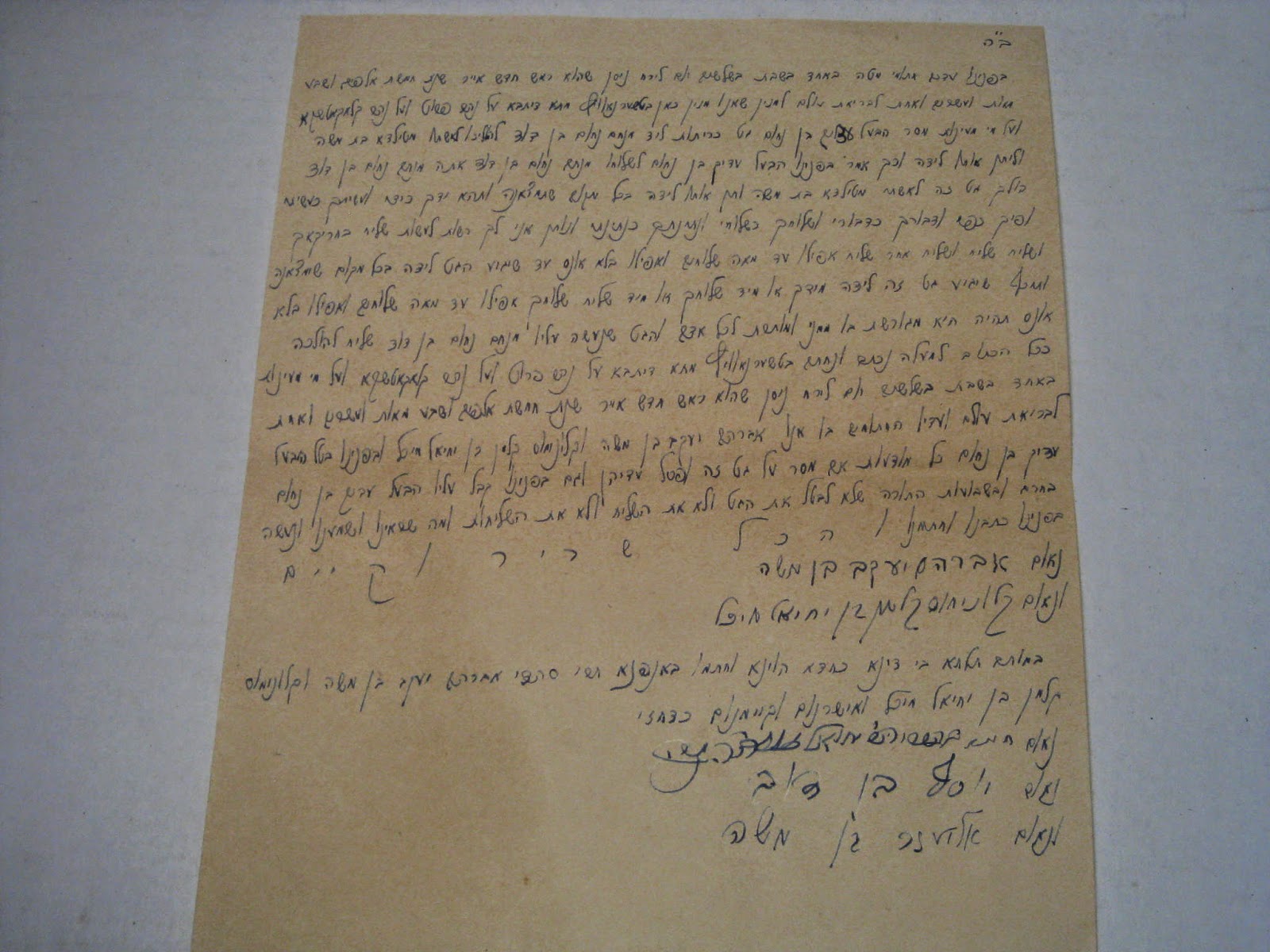
Tucked inside a book I recently acquired I came across an interesting telegram sent from Congregation Beth Torah, A Syrian Synagogue in Brooklyn NY to the Office of the Prime Minister in Israel.
The telegram was sent in 1982, shortly before the first term of Rabbi Ovadia Yosef's Chief Rabbinate was to conclude. There was much debate in Israel at the time if to allow a second term. Eventually a law was passed preventing a Chief Rabbi from officiating for more than one term, thus preventing Rav Ovadia's reelection. The law which was widely viewed as being directed against R. Ovadia specifically was passed in part with support from Moshe Nissim, the secretary of treasury at the time, who was the son of the previous Chief Rabbi, Yitzchak Nissim
This telegram requests that the additional term be approved and is signed by the Rabbi of Beth Torah at the time, Rabbi Zebulun Lieberman. A noble effort, which unfortunately did not succeed.
Sunday, September 28, 2014
A Customer in Qatar building a library of Hebrew Anti-Zionist works by Rav Yoel Teitelbaum
I have sold books in the past to several customers of Muslim Faith in the Middle-East so was not all too surprised when an order came in from Qatar, but his choice of books was rather depressing to say the least.
After making several purchases of Hebrew grammar and language instruction works, he went on to purchase a slew of Satmar Anti-Zionist works, starting with Vayoel Moshe and down to current living Anti-Zionist Satmar authors.
Here is a look at his most recent order
Sometimes you wonder if Rav Yoel Teitelbaum intended his teachings to continue and be preached in the current situation in Israel, where lives are literately at stake when Jews preach Anti-Zionism or if Rav Yoel's teachings were intended for his time and place and perhaps he himself would have changed his ideology in light of the current times, when most of the Jewish People in the world live in Israel and it is the center of Torah Study in the world. It is safe to say though, that the authors of these Anti-Zionists works did not intend for there books to be read in Qatar, now the safe-haven of Hamas, and ultimately be used in an excuse to push the Jews towards the Mediterranean Sea.
Instead of cancelling the order, I sent his shipment along with free extras, of more balanced books on Zionism, with hopes that it might be of some influence.
After making several purchases of Hebrew grammar and language instruction works, he went on to purchase a slew of Satmar Anti-Zionist works, starting with Vayoel Moshe and down to current living Anti-Zionist Satmar authors.
Here is a look at his most recent order
Sometimes you wonder if Rav Yoel Teitelbaum intended his teachings to continue and be preached in the current situation in Israel, where lives are literately at stake when Jews preach Anti-Zionism or if Rav Yoel's teachings were intended for his time and place and perhaps he himself would have changed his ideology in light of the current times, when most of the Jewish People in the world live in Israel and it is the center of Torah Study in the world. It is safe to say though, that the authors of these Anti-Zionists works did not intend for there books to be read in Qatar, now the safe-haven of Hamas, and ultimately be used in an excuse to push the Jews towards the Mediterranean Sea.
Instead of cancelling the order, I sent his shipment along with free extras, of more balanced books on Zionism, with hopes that it might be of some influence.
The commentary Leket Bahir on Rashi and the change of tone in the language between the editions
Yeshaya Halevi Weiss was a learned busdriver from Monroe, New York, who wrote an excellent commentary on Rashi and on the Ohr Hachaim, which he named Leket Bahir and Ohr Bahir.
In his commentary on Rashi, he often takes the Sifte Chachamim written by Shabbethai Bass to task and in his commentary Leket Bahir often used very harsh words and verbal attacks against the Sifte Chachamim.
In his second edition, Weiss appears to have had a change of heart on this matter and a notice was placed following the title page stating:
אחרי שובי נחמתי מלבא ולצאת נגד הש"ח בלשונות חדים קשים ומדקירים. הלא דברי חכמים בנחת נשמעים......
Upon my return, I regret my coming and going against the Sifte Chachamim with harsh and sharp words like swords... words of the wise are accepted when said in a soft manner....."
The harsh words against the Sifte Chachamim were removed in the later editions, but the pagination and page layout was not changed, thus creating empty spaces in the middle of the text as seen in scans above.
hat-tip: Menachem Silber
In his commentary on Rashi, he often takes the Sifte Chachamim written by Shabbethai Bass to task and in his commentary Leket Bahir often used very harsh words and verbal attacks against the Sifte Chachamim.
In his second edition, Weiss appears to have had a change of heart on this matter and a notice was placed following the title page stating:
אחרי שובי נחמתי מלבא ולצאת נגד הש"ח בלשונות חדים קשים ומדקירים. הלא דברי חכמים בנחת נשמעים......
Upon my return, I regret my coming and going against the Sifte Chachamim with harsh and sharp words like swords... words of the wise are accepted when said in a soft manner....."
| The statement of the Author above in the second edition, retracting his harsh criticism of the Sifte Chachamim |
The harsh words against the Sifte Chachamim were removed in the later editions, but the pagination and page layout was not changed, thus creating empty spaces in the middle of the text as seen in scans above.
hat-tip: Menachem Silber
An Uncensored Plagiarized copy of Talmudic Terminology by Nosson Dovid Rabinowich Ironicly inscribed to Rabbi Ovadia Yosef
Below are scans of a noted and ironic copy of Talmudic Terminology by Nosson Dovid Rabinowich, which was inscribed to Haham Ovadia Yosef. Shortly after publication, it was brought to light that this work was plagiarized from Moses Mielziner's Introduction to the Talmud and a new edition was published, removing the Haskamah of Rav Ovadia Yosef from the book and with attribution to Mielziner.
A Summary of the affair from the SeforimBlog:
In 1988, Rabbi Nosson Dovid Rabinowich published a book titled Talmudic Terminology. However, as was noted in brief by Dr. Marc Shapiro, this was plagiarized from Moses Mielziner's Introduction to the Talmud, first published in 1894. This omission, however, has been corrected in Rabinowich's reprints of his Talmudic Terminology where the title now reads that Rabinowich's work is "adapted" from Mielziner's.
While this would appear to be the end of the matter it is not. Dr. Shapiro has investigated this issue further and has sent the following:
After I published my book on Saul Lieberman and the Orthodox a number of people pointed out to me that Nosson Rabinowich's plagiarism of Mielziner is more extensive than what I point out. I didn't know what they were referring to since I had the first edition of his book M. Mielziner's Talmudic Terminology, published in 1988 (in my kuntres there is a typo, as it says 1998). Or so I thought. I succeeded in locating another copy by interlibrary loan, and lo and behold, the title page does not say M. Mielziners Talmudic Terminology adapted by N. Rabinowich but it identifies him as the author. What's even more fascinating is that the other edition has haskamot of Rabbis Ovadiah Yosef and Aharon Feldman. Obviously when the scandal broke, Rabinowich quickly produced a new title page and took out the haskamot (and also added a note on p. xv and made a slight change in note 2 on. p. xv (replacing "some" with "most".) It is obvious why the haskamot were taken out, since they praise Rabinowich for producing a book which he didn't write. In fact, Rabinowich is responsible for something very interesting. We find here the first example in history where gedolim put a haskamah on a work written by a Reform rabbi! Unknowingly Rabbis Yosef and Feldman gave a haskamah to Mielziner. You can be sure this is not something that makes them happy.
Additionally, in an effort to keep the two "editions" the same, Rabinowich did not alter the pagination, this is so, even though he removed the haskamot. Consequently, the "new" edition is missing those pages.
hat-tip; Jimmy Betesh
An Artscroll Shas with a history - A Siyum made by a husband and wife
I recently acquired an Artscroll Hebrew-English Shas from an elderly man whose wife has just passed on. He related to me, how he and his wife completed the Shas together with the aid of an Artscroll and now that his wife is no longer with him, he decided to sell his second set, leaving himself with one complete set for himself.
I sold the set to a local customer who related how decades ago, he participated in a Siyum Hashas made by a different couple, completed using a Soncino Translation of the Talmud, he recalled that Rav Dovid Cohen from Gvul Yaavetz attended and gave a speech at this siyum.
Tuesday, August 12, 2014
Rabbi Yehonatan Eybeschutz's thoughts on the practice of receiving Haskamot
| from the introduction of Kereti U'Peleti by Eybeschutz' |
When Eybeschutz printed his book Kereti U'Peleti, he opted out of this practice and gives an interesting logic for his reasoning. He writes that if he has yet to sell out his own copies of his printing, why would anyone else attempt to print it, when it most likely will end up as a financial failure, as he himself can't sell his copies.
If he has indeed has sold out his copies, then why stop anyone else from printing his book, as he will incur no loss from it, as his copies have already sold.
This statement of Eybeschutz, appealed to several later authors as well, and was used in several other book printings, for example the commentary on Iyov published in 1791 in Prague with a commentary by יב"א, who quotes Eybeschutz in his reasoning for not getting a Haskamah for his book.
| איוב עם פרוש יב"א 1791 |
Rabbi Ahron Milevsky of Montevideo, Uruguay and כרכשאות
It is interesting to see how words that haven't been used for many years manage to survive in Rabbinic circles, long after the more modern term is widely used and the old word is no longer understandable to the vast majority of the speakers of the language.
I came across recently, a letter sent from Uruguay, by Rabbi Ahron Milevsky to Rav Yosef Eliyahu Henkin in NY, dated 1957. Milevsky requested an immediate response to the Kashruth status of the wrappers of כרכרשאות sold in Uruguay by the Ford company. He attached a sample of the wrapper to the letter, having it stapled on.
The word כרכרשאות which means sausages, is derived from the Aramaic work כרכושתא, which appears in the Talmud Baba Metzia 85. The word word appears regularly in scattered Rabbinic writings, for example in the Tur Choshen Mishpat 306 והטבחים שלוקחין הכרכשתות מן הכשרות נקרא שפיר בשכר. Agnon used it once as well שהיה מכיר אפלו בתוך הקוגיל כרכשתא שנגנבה הימנו" עגנון, אלו כ
By the early 1900s the word נקניק was by the far the word that was used for sausages. נקניק appears but כרכושתא does not in Ben Yehuda, Alcalay, Megiddo and other Hebrew Dictionaries of the day. Occasionally Jews would use the old German word for sausages as well וואורשט, in some advertisements in Rabbinic Journals in the mid-1900s, you are able to see both words still in use, often together and interchangeably. Here is one such ad from Hapardes
And here is an ad page from the Journal היהודי from 1937, showing 2 different ads, one used the old term כרכשתות and the one by Hebrew National using Sausage (In Hebrew Letters) as well as the Yiddish term וואורשט
I came across recently, a letter sent from Uruguay, by Rabbi Ahron Milevsky to Rav Yosef Eliyahu Henkin in NY, dated 1957. Milevsky requested an immediate response to the Kashruth status of the wrappers of כרכרשאות sold in Uruguay by the Ford company. He attached a sample of the wrapper to the letter, having it stapled on.
The word כרכרשאות which means sausages, is derived from the Aramaic work כרכושתא, which appears in the Talmud Baba Metzia 85. The word word appears regularly in scattered Rabbinic writings, for example in the Tur Choshen Mishpat 306 והטבחים שלוקחין הכרכשתות מן הכשרות נקרא שפיר בשכר. Agnon used it once as well שהיה מכיר אפלו בתוך הקוגיל כרכשתא שנגנבה הימנו" עגנון, אלו כ
By the early 1900s the word נקניק was by the far the word that was used for sausages. נקניק appears but כרכושתא does not in Ben Yehuda, Alcalay, Megiddo and other Hebrew Dictionaries of the day. Occasionally Jews would use the old German word for sausages as well וואורשט, in some advertisements in Rabbinic Journals in the mid-1900s, you are able to see both words still in use, often together and interchangeably. Here is one such ad from Hapardes
And here is an ad page from the Journal היהודי from 1937, showing 2 different ads, one used the old term כרכשתות and the one by Hebrew National using Sausage (In Hebrew Letters) as well as the Yiddish term וואורשט
Collection of Gittin from Chernovitz (Chernivtsi) under Soviet Union 1961-1962
I recently acquired a First Edition copy of Kav Naki, a classic work on Hilchot Gittin, the Jewish Laws of divorce. The copy had the signatures and stamps of Rabbi Ezra Kalischer, the Av Bet Din in Chernovitz. There is a responsa written to him by the Maharsham, published in Shu"t Maharsham Vol 6, siman 27, dated 1897.


Upon opening the book I discovered a stash of Divorce Documents for divorces that took place in Chernovitz mostly in the years 1961-1962. Chernovitz was under Soviet Union since WWII and the writing of Gittin was more than enough to get you in trouble with the authorities, but it appears an underground Bet Din continued to be active, even under Soviet Rule. Judging from the date, it appears the Gittin were written by a different owner of the book, other than Kalischer.
The same 2 signatures appear in nearly all the documents, that of
קלונימוס קלמן בן יחיאל מיכל
אברהם יעקב בן משה
Upon opening the book I discovered a stash of Divorce Documents for divorces that took place in Chernovitz mostly in the years 1961-1962. Chernovitz was under Soviet Union since WWII and the writing of Gittin was more than enough to get you in trouble with the authorities, but it appears an underground Bet Din continued to be active, even under Soviet Rule. Judging from the date, it appears the Gittin were written by a different owner of the book, other than Kalischer.
The same 2 signatures appear in nearly all the documents, that of
קלונימוס קלמן בן יחיאל מיכל
אברהם יעקב בן משה
Thursday, July 10, 2014
Rabbi Eliyahu Rusoff of the Bronx and his beating on the subway
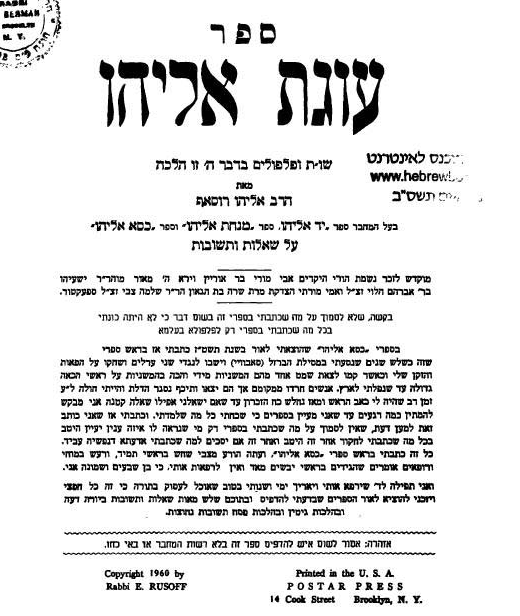
Rabbi Eliyahu Rusoff was Rabbi was in the Bronx for many years, and authored several interesting works, mostly Responsa. c1952 the Rabbi was riding on the subway and two gentiles seated facing him were poking fun at his sidelocks and beard and as they got up to leave the train, one of them took the Mishnah volume he was holding and hit him on the head with the book, hitting him so hard that he fell down. They escaped, and the Rabbi spent the next years in pain, with headaches and loss of memory.
The author printed this story that occurred to him on the title page of every book he published after this event, stating that you can not rely on anything written in the book for practical purposes as his memory is now failing and the doctors do not want to attempt to heal him as he is aged 78...
Rabbi Rusoff had an interesting style in his writing, when he would be quoting or be responding to what has been written in another book, he often quoted the entire portion word for word, often several columns long. At times, it is hard to tell where the quote ends and his comments on it begin.
Some things of note from his books:
in כסא אליהו
דף יב: discusses gentiles who kept all their utensils kosher, and then converted, can their utensils be used?
כג: is וצוונו said at the circumcision of a Convert?
ל: Is Euthanasia permitted?
לג: Would the purchase of a buyer, who was sent seforim without his request, be considered legitimate or must we suspect that he purchased it out of embarrassment (pressure)? Ref. to Minchas Eliyahu [pg. 35a]
מ: sitting shivah when one knows death of a relative is imminent.
On the title page of his Yad Eliyahu, he writes that this book was written in a response to Ba'ale Batim who complained of authors who request their help to publish works of no use to them, this work was intended and can be understood even by the layman.
One of the sponsors of the book Minchat Eliyahu is Manfred R. Lehman
hat-tip: Ovadya Hoffman
Photo hat-tip: YD Miller
The author printed this story that occurred to him on the title page of every book he published after this event, stating that you can not rely on anything written in the book for practical purposes as his memory is now failing and the doctors do not want to attempt to heal him as he is aged 78...
Rabbi Rusoff had an interesting style in his writing, when he would be quoting or be responding to what has been written in another book, he often quoted the entire portion word for word, often several columns long. At times, it is hard to tell where the quote ends and his comments on it begin.
Some things of note from his books:
in כסא אליהו
דף יב: discusses gentiles who kept all their utensils kosher, and then converted, can their utensils be used?
כג: is וצוונו said at the circumcision of a Convert?
ל: Is Euthanasia permitted?
לג: Would the purchase of a buyer, who was sent seforim without his request, be considered legitimate or must we suspect that he purchased it out of embarrassment (pressure)? Ref. to Minchas Eliyahu [pg. 35a]
מ: sitting shivah when one knows death of a relative is imminent.
On the title page of his Yad Eliyahu, he writes that this book was written in a response to Ba'ale Batim who complained of authors who request their help to publish works of no use to them, this work was intended and can be understood even by the layman.
One of the sponsors of the book Minchat Eliyahu is Manfred R. Lehman
hat-tip: Ovadya Hoffman
Photo hat-tip: YD Miller
Tenuvot Yehuda תנובת יהודה by Rabbi Reuven Fink An Interesting Bibliographical Note
Rabbi Reuven Fink (נולד תקצ"ה - נפטר תר"ס) authored a book titled Tenuvot Yehuda. The author writes on the title page, that any student of the talmud and it's commentaries who wants to study my book and can not afford it, shall reach out to me and I'll send him a copy for free.
The place of printing is described as Cracow, published by Yosef Fischer and dated 1896. On the title it states that the printing started in Tevet 5695 (1895) and halted in middle, until the author approached the printer Fischer in Cracow and through him the printed was completed in Adar 5696 (1896)...
At end of book, in the errata, the author writes how the mistakes are all the fault of the first publisher and for the sake of the first publisher he will not mention his name.
A look at the fonts used in the book shows that the first publisher published until page 98, the balance of book, as well as title, errata and introduction were published by the second publisher, in Cracow.
The place of printing is described as Cracow, published by Yosef Fischer and dated 1896. On the title it states that the printing started in Tevet 5695 (1895) and halted in middle, until the author approached the printer Fischer in Cracow and through him the printed was completed in Adar 5696 (1896)...
At end of book, in the errata, the author writes how the mistakes are all the fault of the first publisher and for the sake of the first publisher he will not mention his name.
A look at the fonts used in the book shows that the first publisher published until page 98, the balance of book, as well as title, errata and introduction were published by the second publisher, in Cracow.
Subscribe to:
Posts (Atom)