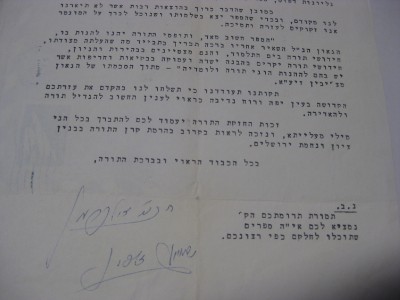
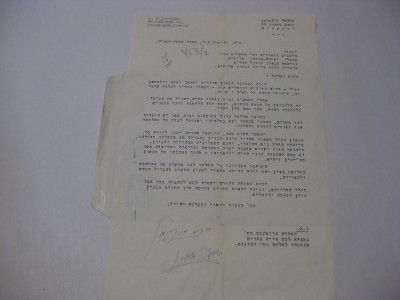
Here is the original newspaper article.
Tuesday, February 19, 2013
Hanoch Albeck and his Anarchist Side: His reasons for refusal the Israel Prize
Hanoch Albeck was awarded the coveted Israel Prize in 1957, just 4 years after the prize was introduced in 1953. As a matter of principle, Albeck refused to accept the award and the handsome cash (tax-free) prize that comes with it. His reasoning was twofold: 1. The abundance of prizes given out, made the importance of any prize almost valueless. 2. The heavy tax burden placed on the general population do not justify the use of them for such questionable reasons and I would fear to get any benefit from such monies.
Friday, February 15, 2013
Noted Rabbi, Jewish Book Dealer and author ARRESTED for attempted Child Rape
A noted Brooklyn Rabbi was arrested Wednesday for allegedly trying to solicit services online from a police officer he thought was a 14-year-old girl. His website, offering his rare Jewish Books for sale, seems to be current and running as of now. He faces up to four years in prison if convicted of attempted rape and other counts. The rabbi held services and runs his Jewish Heritage Tours out of his home in Brooklyn. In 1988 he was in the news as well for his plagiarizing in a book titled Talmudic Terminology he published.
Here is a link to a news article about the story.
Update: as of today, March 5th, his websites are all down, it seems that the world will now have to put up with one less bookdealer-for now.
Here is a link to a news article about the story.
Update: as of today, March 5th, his websites are all down, it seems that the world will now have to put up with one less bookdealer-for now.
Thursday, February 14, 2013
Scathing Letter by Hirsch Lehren against Moses Montefiore
I just acquired a scarce work, titled ארכיונו של החכם באשי ר׳ חיים אברהם גאגין : לתולדות ״מלחמותיהם״ של אדוקי ירושלים published by דינבורג, בן־ציון in 1929 in Jerusalem. It consists of a collection of letter sent to the Haham Bashi Chaim Avraham Gagin. Included are several letters written Zvi Hirsch Lehren of the leaders of the Jewish Community in Amsterdam and a great supporter of the Old Yishuv in Jerusalem. The letters are a surprising attack on Moses Montefiore on many fronts.
Lehren's main opposition to Montefiore is his support of opening a Modern School in Jerusalem under a man named Levenstein, who Lehren adds for the title of Yemach Shemo. Levenstein wasn't too interested in religion and the Rabbinate in Jerusalem naturally opposed the school. Lehren is frustrated with Montefiore's promises that nothing will be done against the wishes of the Rabbinate of Jerusalem all the while pushing for the opening of the school. Even the great amounts of charity dispensed by Montefiore in his 1839 visit to Jerusalem is taken in bitterly by Lehren who says that very little of the monies donated ever trickled down to the real needy in Jerusalem. He does not spare in his wording either.
I find it fascinating that no one in history who is now remembered led a life without opposition, such is the nature of humanity
Lehren's main opposition to Montefiore is his support of opening a Modern School in Jerusalem under a man named Levenstein, who Lehren adds for the title of Yemach Shemo. Levenstein wasn't too interested in religion and the Rabbinate in Jerusalem naturally opposed the school. Lehren is frustrated with Montefiore's promises that nothing will be done against the wishes of the Rabbinate of Jerusalem all the while pushing for the opening of the school. Even the great amounts of charity dispensed by Montefiore in his 1839 visit to Jerusalem is taken in bitterly by Lehren who says that very little of the monies donated ever trickled down to the real needy in Jerusalem. He does not spare in his wording either.
I find it fascinating that no one in history who is now remembered led a life without opposition, such is the nature of humanity
The library of Rabbi Chaim Heller has been stolen, please keep an eye out for it
I just received a phone call from the granddaughter of Rabbi Chaim Heller. His library, which was in her possession was said to have been plundered after Storm Sandy, anyone who spots any books with his stamps is requested to contact the family.
Monday, February 4, 2013
How Chief Rabbi Yaakov S. Kassin wrote a Pasul Sefer Torah
As a young man, Yaakov Kassin who would later become the first Chief Rabbi of the Syrian community of New York, was a brilliant scholar and orator. His Bar Mitzvah speech is a genuine work of art. His Father immediately after his Bar Mitzvah, apprenticed him at a local Sofer, to learn the trade of writing Stam. Within months, he finished writing a Sefer Torah which was given to the Yeshivat Hamekubalim Beth El in Jerusalem. The writing was said to be a beauty to behold. Shortly after, his father discovered his birth certificate in which it was found out that they miscalculated his age. He was just 12 years old and not 13, thus the Sefer Torah he wrote was Pasul. (Princely Wisdom, pg 31)
The Sefer is still around and I have been told by people who saw it, that it's beauty is still apparent.
Saturday, February 2, 2013
Signed verse Unsigned Jewish books, is there always a difference?
Every week or so, on average, I get a phone call that goes something like this. "I was just cleaning up my adopted grandmother's attic and found this beautiful large book, called Pirke Aboth by the artist Saul Raskin, it is just beautiful and it is signed! What is it worth?" The answer is of course not much. I happen to think the book's art is indeed gorgeous, book the book is very common as well. And it seems, unsigned copies are rarer than signed ones. Raskin often sold his wares door to door in Brooklyn, and if you bought his book we would throw in his signature for free. The vast majority of Raskin's books I come across are thus signed. The more expensive works of his seem to be signed less often, perhaps because these were less often sold in this manner.
Almost Everyone enjoys a nice book signed by the author. It adds a touch of personal flavor and a feeling of closeness that comes with holding a book you know the author once signed. But not always does that mean they have more value or scarce in any way. James Ellroy for example, is known for signing every copy of the 65,000 strong first run of My Dark Places. With Jewish books, there are entire categories of books which come signed more often than that. Take 20th century Yiddish books for example. Yiddish books in the last century were often self-published by the authors and thus were being sold personally with no distributors involved. This period in Yiddish writing is characterized by the need of every self-respecting Yiddish speaker to write a book, whether or not anyone in the world would ever want to read it. Such titles run from auto-biographies and Poetry to short stories and Novels. In general, the authors were left behind with numerous copies which they would eventually give out to old and new friends and at every occasion, usually with an inscription attached. There was also a great interactions between the various Yiddishists, which gave reason to each of them inscribing his books to other Yiddish authors. The result is a great percentage of Yiddish books which are signed and/or inscribed by the authors. This in turn leads to their value being very little over what and unsigned copy would be worth.
One the other hand, some authors almost never signed their books. Take some modern prolific authors for example, Aryeh Kaplan or Gershom Scholem, I have rarely encountered signed copies of their works. On the other hand, some authors seem to have signed every book they can get a hand of, a few examples being, James Grover McDonald in his work My Mission in Israel, H. Sklar and Daniel Persky.
Early printed works are rarely signed as well, it is extremely rare to find an 18th century or earlier book with an author's inscription. The cost of the printing of books until the modern age, was prohibitive enough that they were rarely passed around as gifts. Ladino literature as well I have only rarely seen with an author's inscription.
There are a few general rules to keep in mind to determine if a book being signed is not common. Self-published books are most often signed, the cost of the book for the author being less than otherwise and the fact that many are often left unsold makes Self-published Signed books more common. The older the book, the less chance of the author signing it as well. Scholarly works and works of non-fiction seem to be signed less often than fiction. The more specific the title, the less chance of it being inscribed. For example, the history of the Jews of Salonica in the 18th century will most likely be less prone to have an inscription than a novel for Jewish Youth. Sermons are more likely to be signed as well.
Another thing to keep in mind, is that if the author owned the printing press, he was much more liberal with giving and inscribing books of his. This is evident for example in the works of Rabbi Yeshaya Dayan who had a printing press in Aleppo in the last 19th century, the work that he wrote comes signed more often than not. Eliyahu ben Amozag as well, printed his works in his printed press in Livorno and his inscriptions come around regularly as well.
Regardless of value, signed books are a great addition to any collection and a special touch to any book. This is especially the case with an author you have a special affinity for or an important person. Good Luck Collecting!
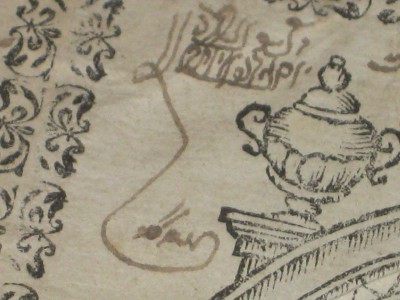
Almost Everyone enjoys a nice book signed by the author. It adds a touch of personal flavor and a feeling of closeness that comes with holding a book you know the author once signed. But not always does that mean they have more value or scarce in any way. James Ellroy for example, is known for signing every copy of the 65,000 strong first run of My Dark Places. With Jewish books, there are entire categories of books which come signed more often than that. Take 20th century Yiddish books for example. Yiddish books in the last century were often self-published by the authors and thus were being sold personally with no distributors involved. This period in Yiddish writing is characterized by the need of every self-respecting Yiddish speaker to write a book, whether or not anyone in the world would ever want to read it. Such titles run from auto-biographies and Poetry to short stories and Novels. In general, the authors were left behind with numerous copies which they would eventually give out to old and new friends and at every occasion, usually with an inscription attached. There was also a great interactions between the various Yiddishists, which gave reason to each of them inscribing his books to other Yiddish authors. The result is a great percentage of Yiddish books which are signed and/or inscribed by the authors. This in turn leads to their value being very little over what and unsigned copy would be worth.
One the other hand, some authors almost never signed their books. Take some modern prolific authors for example, Aryeh Kaplan or Gershom Scholem, I have rarely encountered signed copies of their works. On the other hand, some authors seem to have signed every book they can get a hand of, a few examples being, James Grover McDonald in his work My Mission in Israel, H. Sklar and Daniel Persky.
Early printed works are rarely signed as well, it is extremely rare to find an 18th century or earlier book with an author's inscription. The cost of the printing of books until the modern age, was prohibitive enough that they were rarely passed around as gifts. Ladino literature as well I have only rarely seen with an author's inscription.
There are a few general rules to keep in mind to determine if a book being signed is not common. Self-published books are most often signed, the cost of the book for the author being less than otherwise and the fact that many are often left unsold makes Self-published Signed books more common. The older the book, the less chance of the author signing it as well. Scholarly works and works of non-fiction seem to be signed less often than fiction. The more specific the title, the less chance of it being inscribed. For example, the history of the Jews of Salonica in the 18th century will most likely be less prone to have an inscription than a novel for Jewish Youth. Sermons are more likely to be signed as well.
Another thing to keep in mind, is that if the author owned the printing press, he was much more liberal with giving and inscribing books of his. This is evident for example in the works of Rabbi Yeshaya Dayan who had a printing press in Aleppo in the last 19th century, the work that he wrote comes signed more often than not. Eliyahu ben Amozag as well, printed his works in his printed press in Livorno and his inscriptions come around regularly as well.
Regardless of value, signed books are a great addition to any collection and a special touch to any book. This is especially the case with an author you have a special affinity for or an important person. Good Luck Collecting!
Wednesday, January 23, 2013
A coming Judaica Auction Catalog: a look in to the psychology of auction buyers
A New York Auction House is set to have their next Judaica Auction this coming week. I just finished going through the catalog, and as usual there are some really nice books which I would not mind owning to say the least. A nice volume of a Bomberg Talmud, or a 1st Edition of Menasseh Ben Israel's Nishmat Adam for example. But what struck me most was the abundance of books offered which are being offered at multiple times their retail value. This phenomenon is in not limited to this auction or auction house, the major auction houses seem to be able to sell pretty much anything, even if the same item can be gotten for a fraction of the price elsewhere.
Here are just a few examples of the many in the current catalog. Item 98 offers The Hagadah of Passover. Edited by David and Tamar de Sola Pool. For Members of the Armed Forces of the United States. Just for a background, 550,000 Jews served in the US Armed forces in WWII. Every soldier was issued one of these Haggadot, they are thus not rare in any way. The asking price currently by competitive booksellers is $40-50. If you prefer to buy at auction, the estimate is $300 - $400.
Take a look at item 68 as well, offerring White, William Charles. Chinese Jews, the classic 3 volume set which you can buy now online for under $200. We sold a set in the store just this week for $120. Auction's asking price? $600 - $900. Item 60 offers He'ach published by Tomchei Temimim in Lubavitch. This is indeed a nice historical item, but any honest dealer will ask for no more than $250 for it, while in the auction the reserve is set at $1,000. There are scores of other items like this throughout the auction as well. After a quick search online, I was able to find items 18, 37, and 38 online for pennies on the dollar as well. What, if so, is the reason behind this? Why would someone pay multiple times the value of something for an item they can get for a few pennies elsewhere?
I have found that the psychology behind these purchases are several. Firstly, there is the prestige of buying at auction. I have many a time, viewed collections, where the auction tags are prominently displayed with the item purchased, ensuring that every observer knows where the item was purchased. I have heard many an ignorant collector take pride in buying something at say Sotheby's for example, though he couldn't for the life of him tell you anything about it. To prove this is true, ask any dealer and they can vouch this happens more often than not, when underbidders are offered a second copy of an item they bid on just seconds ago, they invariably turn it down. Nothing has changed in those few interim seconds other than their ability to say they bought it at auction. Not that there is anything wrong with buyers who buy this way, I just think it is an interesting observation. If a buyer is willing to pay for the experience, so be it.
Another factor, unfortunately, is auction houses intentionally preying on clueless customers. If, for example, they know they have an uniformed customer who collects Haggadot and lacks a specific one, they intentionally multiply the price, describe it as "rare" and place it in auction even though otherwise it would be of no interest. Several auction houses have been caught shill bidding against real bidders as well. Often, there may be a dealer involved as well, who may go as far as placing an item in an auction, and then go and convince one of his customers to bid on the item.
A final ingredient in the magic-spell cast by auctions was uncovered by researchers from Princeton. Their experiments asked volunteers to play on-line auctions with different rules. Some of these auctions had rules that encouraged over-bidding (like typical open auctions, which most of us are familiar with from movies), and some had rules that encouraged rational behavior (like the eBay structure). With enough guidance from the auction rules, the bidders didn’t end up paying much more than they originally thought was reasonable – but only if they thought they were bidding against a computer programme. As soon as the volunteers thought they were bidding against other live humans they found it impossible to bid rationally, whatever the auction rules.
This implies that the competitive element of auctions is crucial to provoking our irrational buying behavior. Once we’re involved in an auction we’re not just paying to own the sale item, we’re paying to beat other people who are bidding and prevent them from having it.
So it seems Gore Vidal had human nature, and the psychology of auctions, about right when he said: “It is not enough to succeed. Others must fail.”
Here are just a few examples of the many in the current catalog. Item 98 offers The Hagadah of Passover. Edited by David and Tamar de Sola Pool. For Members of the Armed Forces of the United States. Just for a background, 550,000 Jews served in the US Armed forces in WWII. Every soldier was issued one of these Haggadot, they are thus not rare in any way. The asking price currently by competitive booksellers is $40-50. If you prefer to buy at auction, the estimate is $300 - $400.
Take a look at item 68 as well, offerring White, William Charles. Chinese Jews, the classic 3 volume set which you can buy now online for under $200. We sold a set in the store just this week for $120. Auction's asking price? $600 - $900. Item 60 offers He'ach published by Tomchei Temimim in Lubavitch. This is indeed a nice historical item, but any honest dealer will ask for no more than $250 for it, while in the auction the reserve is set at $1,000. There are scores of other items like this throughout the auction as well. After a quick search online, I was able to find items 18, 37, and 38 online for pennies on the dollar as well. What, if so, is the reason behind this? Why would someone pay multiple times the value of something for an item they can get for a few pennies elsewhere?
![]() |
| Brooklyn Museum - A Book Auction at Sotheby's - Thomas Rowlandson |
I have found that the psychology behind these purchases are several. Firstly, there is the prestige of buying at auction. I have many a time, viewed collections, where the auction tags are prominently displayed with the item purchased, ensuring that every observer knows where the item was purchased. I have heard many an ignorant collector take pride in buying something at say Sotheby's for example, though he couldn't for the life of him tell you anything about it. To prove this is true, ask any dealer and they can vouch this happens more often than not, when underbidders are offered a second copy of an item they bid on just seconds ago, they invariably turn it down. Nothing has changed in those few interim seconds other than their ability to say they bought it at auction. Not that there is anything wrong with buyers who buy this way, I just think it is an interesting observation. If a buyer is willing to pay for the experience, so be it.
Another factor, unfortunately, is auction houses intentionally preying on clueless customers. If, for example, they know they have an uniformed customer who collects Haggadot and lacks a specific one, they intentionally multiply the price, describe it as "rare" and place it in auction even though otherwise it would be of no interest. Several auction houses have been caught shill bidding against real bidders as well. Often, there may be a dealer involved as well, who may go as far as placing an item in an auction, and then go and convince one of his customers to bid on the item.
A final ingredient in the magic-spell cast by auctions was uncovered by researchers from Princeton. Their experiments asked volunteers to play on-line auctions with different rules. Some of these auctions had rules that encouraged over-bidding (like typical open auctions, which most of us are familiar with from movies), and some had rules that encouraged rational behavior (like the eBay structure). With enough guidance from the auction rules, the bidders didn’t end up paying much more than they originally thought was reasonable – but only if they thought they were bidding against a computer programme. As soon as the volunteers thought they were bidding against other live humans they found it impossible to bid rationally, whatever the auction rules.
This implies that the competitive element of auctions is crucial to provoking our irrational buying behavior. Once we’re involved in an auction we’re not just paying to own the sale item, we’re paying to beat other people who are bidding and prevent them from having it.
So it seems Gore Vidal had human nature, and the psychology of auctions, about right when he said: “It is not enough to succeed. Others must fail.”
A letter to Rabbi Henkin requesting help in publishing Keren Yishai
Here is a nice piece of History, a letter sent from Rabbi Shmuel Silbermann, requested help from Rabbi Henkin in publishing his father's works Keren Yishai
Monday, January 21, 2013
An unexplainable coincidence, A Library, A Customer & the Sandak
This morning after hauling in to the store a recent library acquired, a customer enters our store. Briefing him on the recent acquisition, I mention offhand that the books came from a fellow who lived for a time in Portland. Turns out the customer had lived in Portland decades ago as well. Not only did the customer know the now deceased owner of the books, the man was his Sandak!
The families were both very good friends and a few phone calls later the widow and the customer were both on the line together reminiscing life in Portland 30 years ago.
Assuming there are 15,000,000 Jews in the world, the chance of walking in to a bookstore who just acquired your Sandak's library is somewhere like 1 in 15 million. Just Fabulous to me!
The families were both very good friends and a few phone calls later the widow and the customer were both on the line together reminiscing life in Portland 30 years ago.
Assuming there are 15,000,000 Jews in the world, the chance of walking in to a bookstore who just acquired your Sandak's library is somewhere like 1 in 15 million. Just Fabulous to me!
Thursday, January 17, 2013
For Posterity the Business Card of ISAIAH BERGER, BOOKSELLER, BROWNSVILLE, BROOKLYN, NY
Isaiah Berger sold Jewish books in the early 1900s, in Brownsville, 125 Dumont Avenue, Brooklyn. His son is Professor David Berger, dean of Yeshiva University. "Judaeo-Oriental Book Service"
Subscribe to:
Posts (Atom)