Monday, August 17, 2015

Loss Prevention of personal library during the Holocaust - Pressburg

In a copy of Anshe Shem of Buber, I came across a stamp stating : ספרי' של יוסף אייכלר פרעסבורג
הספר הזה אם אינו ברשות בעליו מצוה להחזירו כי נגזל או נאבד ע"י הגזירות בשנת התש"ב לפ"ק "
"From the library of Yosef Eichler, Pressburg
This book, if not in the procession of it's owner, it shall be a mitzvah to return it, as it was stolen or lost during the calamities of the year 5742 (1941-42)"

Y. Eichler seeing the approaching devastation seems to have went ahead and stamped his books with this such in hopes of being able to reclaim them in better days.

"Following the creation of an independent Slovak State in March 1939, the Jews of Bratislava were subjected to discriminatory practices and persecution. By the 1st of March 1942, nearly half of the city’s Jews had been evicted, and dispersed in smaller towns across the country. During 1942 many of the Jews of Bratislava were deported to the death camps in Poland.
During the war the city was home to the Bratislava Working Group, which was devoted to rescuing Jews. The group’s efforts, however, came to naught and most Slovakian Jews were murdered in the Holocaust."

Hat-tip: YItzchak Stroh

The Fast of 17th of Tammuz and America's Birthday

by Dr. Shlomo Sprecher
The original adoption of the Declaration of Independence on July 4, 1776 could not receive its proper celebration by the American Jewish community, as it coincided with the fast day of 17 Tammuz (see R. Dovid Heber's column on page 58 of this weeks Yated). As originally discussed in Commentary here, twelve summers later, when New York State's delegates were locked in a bitter debate whether to place New York among the other states ratifying the proposed Constitution, 17 Tammuz once again presented an obstacle. To increase pressure for an affirmative vote, the proponents for ratification scheduled a Grand Federal Procession in NYC, to demonstrate to the nay-voting Up-Staters that Down-Staters were overwhelmingly in favor, to the extent that NYC might even secede from the state in the event of a nay-vote. This massive Procession (which ultimately included a quarter of the entire population of NYC accompanied by a scaled-down frigate, artillery and trumpeters on horseback) was abruptly postponed from July 22 to July 23. The reason? At the last moment it was discovered that the original date coincided with 17 Tammuz and consequently the tiny Jewish community would be unable to participate! Michael Schwartz, whose research provided the basis for this post, surmises that the great respect for the heroism of Gershom Mendes Seixas, the hazzan of the Spanish-Portuguese Synagogue, during the British occupation of NYC, was the impetus behind the decision to postpone the momentous Procession. Schwartz also suggests that it was the Sephardic minhag of only beginning avelut during the week of Tisha b'Av that enabled the Procession to proceed on the 23rd. Had the Ashkenazim been in charge an impossible 3 week postponement would have been required!


Gershom Mendes Seixas

Gershom Mendes Seixas

An Inscription in a Psychology work on the Holiday of Purim

In a copy of Einleitung in die Psychologie als Wissenschaftby Heinrich Spitta, published in 1886, I found an interesting inscription, in Hebrew:


"לכבוד חג הפורים יום גאולת הנפש היהודית מן הכבליים הפסיכיים אשר הומטו עליה בסבת הגלות
אני נותן לך את ספר זה"

חתום מנדל פריד, קלם
"In honor of the holiday of Purim, the day of the freeing of the Jewish Soul from the psychological constraints imposed upon them by the exile, I give you this book, Mendel Fried of Kelm"


Ira Eisenstein, Baruch Litvin, and the Mechitzah

Ira Eisenstein, a founder of Reconstructionist Judaism, along with Mordechai Kaplan ( his future father-in-law), was known for his strong stance against the use of mechitzahs, and Reconstructionist synagogues from their very founding, did not employ a mechitza.

From American Jewish Archives, Spring Summer 1996: In the opinion of his biographer, Mel Scult, "Some of Kaplan's most significant departures from traditional norms concerned the role of women. Kaplan had supported women's suffrage from the pulpit of the Jewish Center, preached several sermons dealing with women in the Bible and  in Jewish history, insisted that women and men have equal voting rights in that institution and continued to encourage women's participation at the SAJ. He advocated mixed seating in both synagogues, but was forced to compromise on this issue (i.e., separate seating but with no mechitza curtain or partition at the Jewish Center). It is well known that he introduced the first Bat Mitzvah ceremony at the SAJ for his daughter, Judith, in 1922, only a few months after its founding. Of course, it was some time before women gained full equality in the congregation;  according to Jack Wertheimer, they were not counted in the minyan or called to the Torah until 1951. The opposition of some members of the congregation slowed the process of women's acceptance, as is evident in the 1945 debate regarding the granting of aliyot (blessings before and after the Torah readings) girls post Bat Mitzvah or confirmation. Kaplan was in favor of the proposal, and opinion was divided among the SAJ membership. A decision-to be made by the members was postponed pending further discussion. Nevertheless, women achieved significant equality at  the SAJ long before the issue was even raised in other American synagogues, and gender equality has remained a central principle of the Reconstructionist movement.

It was thus amusing to see a copy of Baruch Litvin's landmark pro-mechitza book, The Sanctity of the synagogue, warmly inscribed by the author to Ira Eisenstein, "that he may personally review it and "Hew to the line, and let the chips fall where they may". Trying to win him over perhaps?

The Sanctity of the Synagogue, inscribed by the author to Eisenstein


Great expectations - from an inscription in a book - Brașov, Romania 1941 תש"א

Such inscriptions found in books, inscribed during WWII on the eve of the destruction, are a living reminder of how life went on nearly as usual until it was too late. Here is an inscription in a copy of אפרסקתא דעניא by Rabbi David Sperber printed in Batu-Mare in 1940. The owner, inscribing the books,  writes that he purchased it from the Author, who was Av Bet Din in Brașov, Romania. Rabbi Sperber was born in Zablatov, to a family of Vizhnitz Chasidim. A Disciple of Rabbi Meir Arik, from 1908, he served in the rabbinate and in 1928, he became rabbi of BraSov.
"הספר הזה קניתי ממעות מעשר אצל הרב הגאון אב"ד בראשאוו יצ"ועל (ישמרה צורינו ויגן עליה) ביום א לס' קדשים תש"א לפ"ק ובזכות זה יעזור לנו ה' הטוב שנזכה לקנות עוד ספרים כדי שיתרומם קרן התורה ושנזכה לתמוך ביד לומדי התורה עד ביאת גואל אמן"


Hat-tip: Dr S. Sprecher

Sunday, June 21, 2015

An Inscription in a Hebrew Book Feb 18 1944, from Nyírmeggyes, Hungary - Days before total deportation

Found in a copy of Igra DePirka, by R. Zevi Elimelech Shapiro of Dynow printed in 1942 in Munkatch, was a brief inscription:
לדהו"מ קניתי את הספר הקדוש הזה לכבוד צורי וקוני ממעות מעשר שלי בעד 3.90 אשר התניתי מתחלה גם על זה
ב תצוה תש"ד נירמעציעיש יע"א
"To G-d is the world and all it encompasses, I purchased this holy book for the honor of my lord and master, with money set aside for tithes, for the price of 3.90, as per the condition I originally made,
Monday, Parashat Tezaveh (Feb 18, 1944) 5744, Nyírmeggyes, May G-d protect us"

Nyírmeggyes, had a Jewish Population of approximately 250 in 1910. Selective murder and deportation of Hungarian Jews was already taking place since 1941, but shortly after this inscription was written, on March 19, 1944, the total deportation of all Hungarian Jews was decided upon and swiftly carried out.


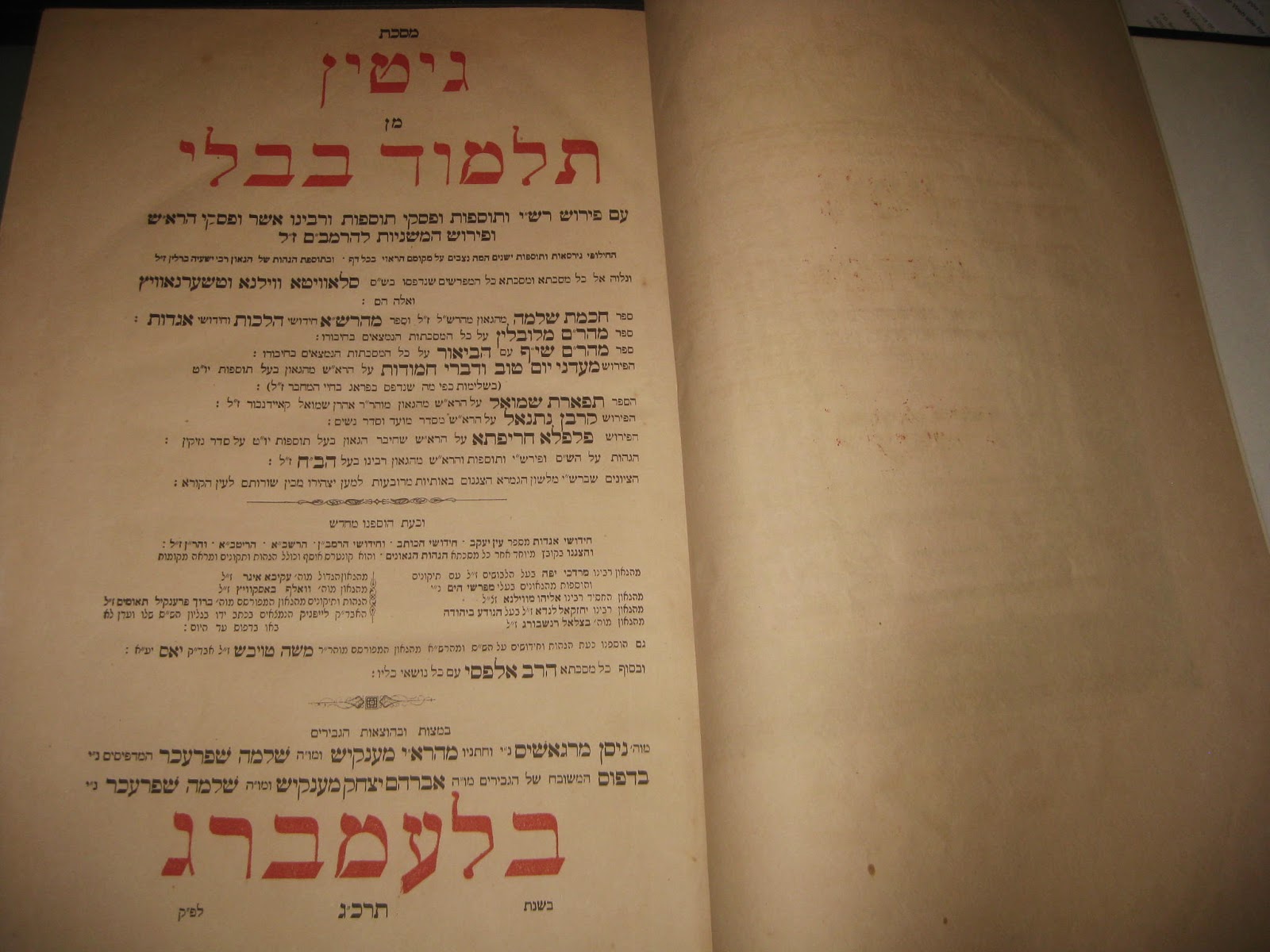
The Hapsburgs vs. the Romanovs Or: Why the Sprecher Shas Beats the Romm Shas

                                             by Dr. Shlomo Sprecher (whose wife purchased a pristine Lemberg Sprecher Shas for her husband’s birthday)

The Lemberg Sprecher Shas (printed in the 1860s) came into immediate use in last week’s Daf HaYomi cycle. The Tosefot on Ketubot 98B cites a query that Rabbeinu Yaakov-Yisrael directed to the Rabbeinu Tam regarding a significant inadvertent over-payment made by an unsuspecting Gentile debtor in paying off his debt to a Jewish moneylender. The moneylender’s agent wished to share in the unexpected windfall, whereas, of course, the moneylender wanted the over-payment for himself in its entirety. What is notable about the query are five Hebrew words “the Gentile could no longer be found,” and so the only issue to be resolved was into whose pocket was the excess to be deposited. What triggered an investigation into this Tosafot was the Rishon with two personal names, Rabbeinu Yaakov-Yisrael, seemingly a feature he shared with no other Rishonim. Turning to Urbach’s classic Ba’alei Tosefot  revealed Urbach citing Haberman citing Urbach that there is internal censorship in that passage. Sure enough, comparing the Lemberg Shas version of Tosefot with the Romm version, quickly proved that the five-word passage was created out of whole cloth by the editors of the Romm Shas not to offend the Russian authorities. Rav Dovid Cohen, in his comprehensive sefer on censored alterations in the Shas missed this one.

A classic Vilna Edition of the Talmud

Sprecher Lemberg Shas

The Sprecher Printing of the Talmud

The Sprecher Printing of the Talmud

R. Dovid Cohen's work on censored Talmudic Portions


The Golem Tackles Nedarim

by Dr. Shlomo Sprecher

At the start of every new Masekhta in the Daf-Hayomi cycle, a member of the Shiur invariably asks, “which Aharonim are needed to do this one right?”

Well, for Nedarim the answer is “elementary.” We need the Mehaber of the Yadot Nedarim! Of course, our indispensable Nedarim problem solver, R. Yudl Rosenberg, is much better known (in our community, at least) as the promoter of the 16th –century’s greatest Superhero – the Golem of Prague. Unfortunately, as in so many other issues affecting the Jewish community, the New York Times just doesn’t get it. The evidence – a review of This Year in Jerusalem, a memoir by Mordecai Richler, a grandson of R. Rosenberg, that appeared in the Times Book Review of November 13, 1994.  Although the review was laudatory, one chapter of the memoir raised the reviewer’s ire: “there was only one dull stretch, a wandering story by Rabbi Rosenberg that the author saw fit to include. Relatives, like dreams, are most interesting to the people who had them, and the rabbi was not the storyteller his grandson is.”

My attempt at correcting the reviewer’s disparagement of a riveting tale of the Golem’s successful intervention to prevent the shmad of a beautiful Jewish girl apparently was not considered “newsworthy" enough. And so, it remained stashed away in my copy of the Yadot Nedarim, that is, until now, when it can finally be shared through the blogosphere.


Keeping up to date in Golem studies is essential, and so the recent publication of the 600-page Maharal compendium by the Zalman Shazar Center should be consulted to avoid error. In particular, Moshe Idel’s article, “On Astral Golems, Dalai Lama, and the Maharal” is not to be missed. As someone whose confusion regarding the correct  R. Eliyahu Ba’al Shem had to be corrected by Prof. Leiman, I speak from experience.


Importing Jewish Books to Iran - The Casablanca Route

Following the Iranian Revolution in 1979, Persian Jews were legally prevented from importing Jewish Books from Israel or the USA, the two main centers of Hebrew Printing. Lacking much of a printing press of their own, Morocco became the only viable source of Hebrew Printing that still had an active Press and was not under a trade embargo.
I found recently a Siddur which was a living example of this, the Prayerbook was printed in Casablanca in 1962 and had several stamps of the Otzar Hatorah school in Tehran, part of the network of schools founded by Isaac Shalom, an American Jewish lay-leader of the Syrian Jewish Community in New York.


A Clear Sign of a very confused Jew

A local G-d fearing Jew gave a knock on the store door this week asking if I can assist him. He was looking for someone who can give some holy books he had that were no longer in use a proper burial. Between the prayerbooks and standard Rabbinic Texts, I found a New Testament, an "Orthodox Jewish Version".