Found in a copy of Igra DePirka, by R. Zevi Elimelech Shapiro of Dynow printed in 1942 in Munkatch, was a brief inscription:
לדהו"מ קניתי את הספר הקדוש הזה לכבוד צורי וקוני ממעות מעשר שלי בעד 3.90 אשר התניתי מתחלה גם על זה
ב תצוה תש"ד נירמעציעיש יע"א
"To G-d is the world and all it encompasses, I purchased this holy book for the honor of my lord and master, with money set aside for tithes, for the price of 3.90, as per the condition I originally made,
Monday, Parashat Tezaveh (Feb 18, 1944) 5744, Nyírmeggyes, May G-d protect us"
Nyírmeggyes, had a Jewish Population of approximately 250 in 1910. Selective murder and deportation of Hungarian Jews was already taking place since 1941, but shortly after this inscription was written, on March 19, 1944, the total deportation of all Hungarian Jews was decided upon and swiftly carried out.
Sunday, June 21, 2015
The Hapsburgs vs. the Romanovs Or: Why the Sprecher Shas Beats the Romm Shas
by Dr. Shlomo Sprecher (whose wife purchased a pristine Lemberg Sprecher Shas for her husband’s birthday)
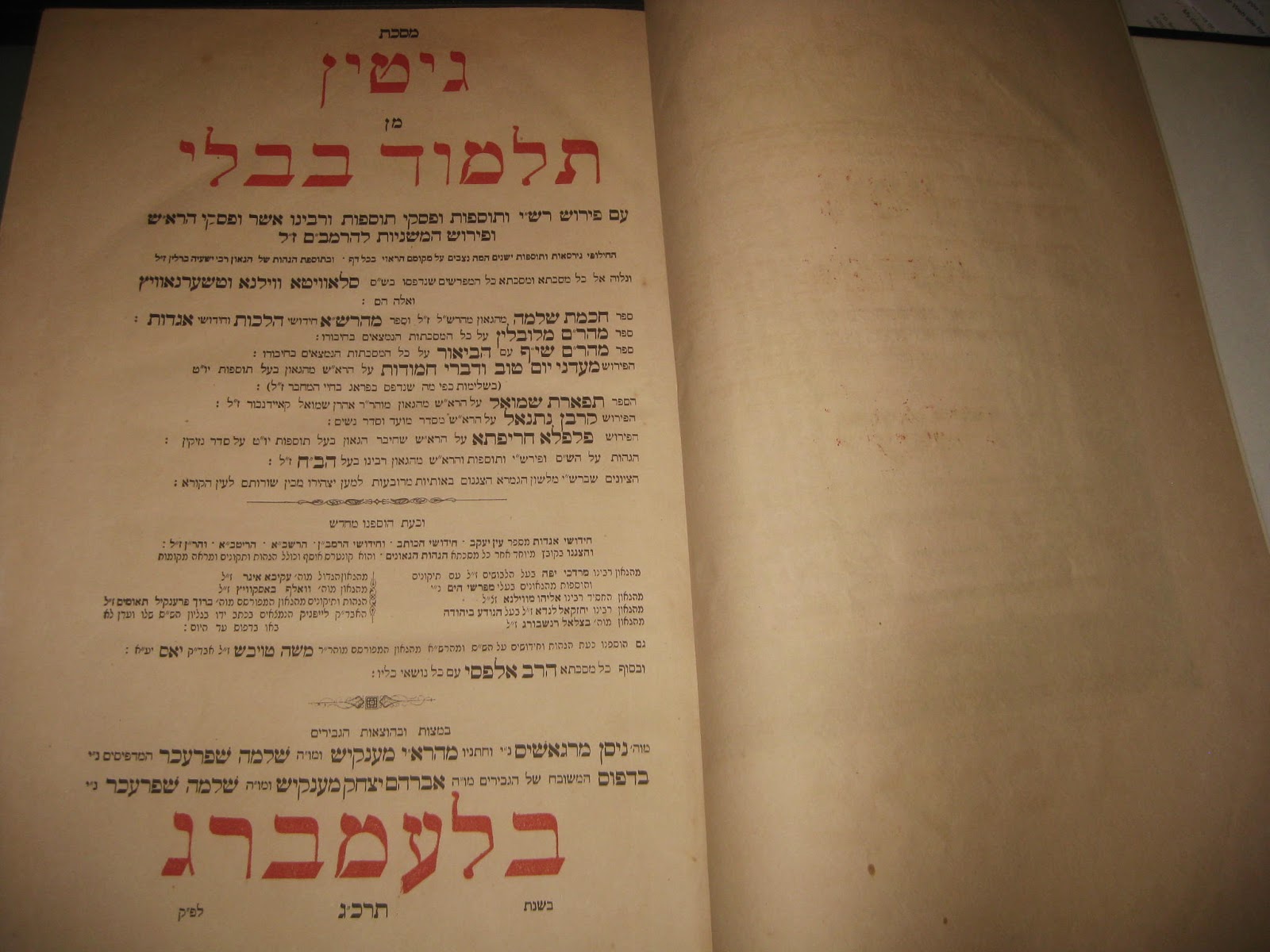
The Lemberg Sprecher Shas (printed in the 1860s) came into immediate use in last week’s Daf HaYomi cycle. The Tosefot on Ketubot 98B cites a query that Rabbeinu Yaakov-Yisrael directed to the Rabbeinu Tam regarding a significant inadvertent over-payment made by an unsuspecting Gentile debtor in paying off his debt to a Jewish moneylender. The moneylender’s agent wished to share in the unexpected windfall, whereas, of course, the moneylender wanted the over-payment for himself in its entirety. What is notable about the query are five Hebrew words “the Gentile could no longer be found,” and so the only issue to be resolved was into whose pocket was the excess to be deposited. What triggered an investigation into this Tosafot was the Rishon with two personal names, Rabbeinu Yaakov-Yisrael, seemingly a feature he shared with no other Rishonim. Turning to Urbach’s classic Ba’alei Tosefot revealed Urbach citing Haberman citing Urbach that there is internal censorship in that passage. Sure enough, comparing the Lemberg Shas version of Tosefot with the Romm version, quickly proved that the five-word passage was created out of whole cloth by the editors of the Romm Shas not to offend the Russian authorities. Rav Dovid Cohen, in his comprehensive sefer on censored alterations in the Shas missed this one.
| A classic Vilna Edition of the Talmud |
| Sprecher Lemberg Shas |
| The Sprecher Printing of the Talmud |
| The Sprecher Printing of the Talmud |
| R. Dovid Cohen's work on censored Talmudic Portions |
The Golem Tackles Nedarim
by Dr. Shlomo Sprecher
At the start of every new Masekhta in the Daf-Hayomi cycle, a member of the Shiur invariably asks, “which Aharonim are needed to do this one right?”
Well, for Nedarim the answer is “elementary.” We need the Mehaber of the Yadot Nedarim! Of course, our indispensable Nedarim problem solver, R. Yudl Rosenberg, is much better known (in our community, at least) as the promoter of the 16th –century’s greatest Superhero – the Golem of Prague. Unfortunately, as in so many other issues affecting the Jewish community, the New York Times just doesn’t get it. The evidence – a review of This Year in Jerusalem, a memoir by Mordecai Richler, a grandson of R. Rosenberg, that appeared in the Times Book Review of November 13, 1994. Although the review was laudatory, one chapter of the memoir raised the reviewer’s ire: “there was only one dull stretch, a wandering story by Rabbi Rosenberg that the author saw fit to include. Relatives, like dreams, are most interesting to the people who had them, and the rabbi was not the storyteller his grandson is.”
My attempt at correcting the reviewer’s disparagement of a riveting tale of the Golem’s successful intervention to prevent the shmad of a beautiful Jewish girl apparently was not considered “newsworthy" enough. And so, it remained stashed away in my copy of the Yadot Nedarim, that is, until now, when it can finally be shared through the blogosphere.
Keeping up to date in Golem studies is essential, and so the recent publication of the 600-page Maharal compendium by the Zalman Shazar Center should be consulted to avoid error. In particular, Moshe Idel’s article, “On Astral Golems, Dalai Lama, and the Maharal” is not to be missed. As someone whose confusion regarding the correct R. Eliyahu Ba’al Shem had to be corrected by Prof. Leiman, I speak from experience.
Importing Jewish Books to Iran - The Casablanca Route
Following the Iranian Revolution in 1979, Persian Jews were legally prevented from importing Jewish Books from Israel or the USA, the two main centers of Hebrew Printing. Lacking much of a printing press of their own, Morocco became the only viable source of Hebrew Printing that still had an active Press and was not under a trade embargo.
I found recently a Siddur which was a living example of this, the Prayerbook was printed in Casablanca in 1962 and had several stamps of the Otzar Hatorah school in Tehran, part of the network of schools founded by Isaac Shalom, an American Jewish lay-leader of the Syrian Jewish Community in New York.
A Clear Sign of a very confused Jew
A local G-d fearing Jew gave a knock on the store door this week asking if I can assist him. He was looking for someone who can give some holy books he had that were no longer in use a proper burial. Between the prayerbooks and standard Rabbinic Texts, I found a New Testament, an "Orthodox Jewish Version".
Monday, May 11, 2015
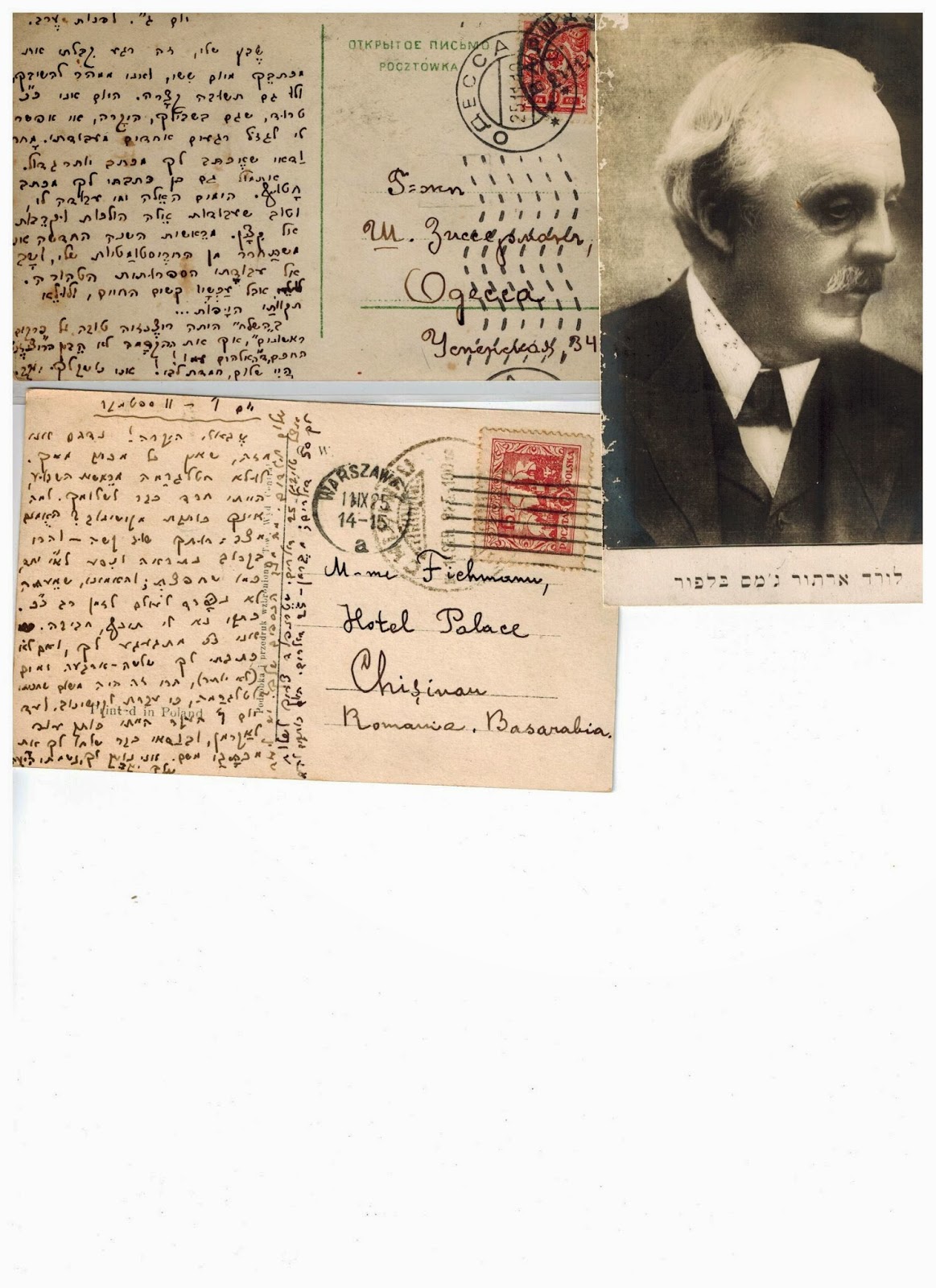
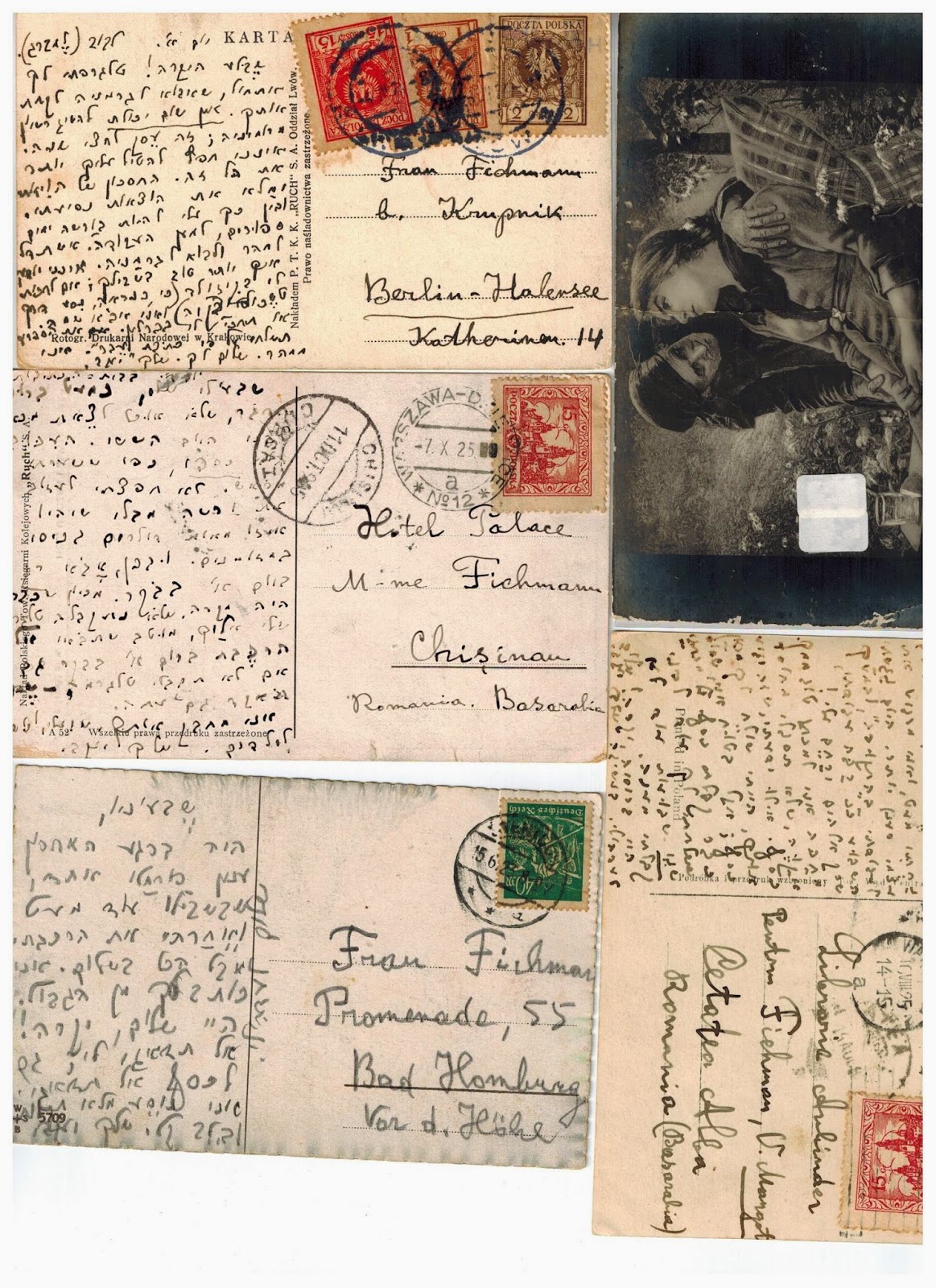
Love letters written by Jacob Fichman to his wife Batsheva During WWI מכתבי אהבה של יעקב פיכמן
I discovered recently a great trove of Hebrew Postcards sent from Jacob Fichman to his wife, after they were separated from each other during WWI. He moved from city to city and from job to job, for a while working for the publishing house Tushiya. She appears to have been in Chisinau and in Odessa during the war.
His letters bear a common theme, he is rather upset with Shevale, his nickname for his wife Batsheva, for not corresponding regularly and never at length. He also writes of his attempts to send her money, but that the war conditions were preventing any such transfer of funds. Much insights can be gleaned from his writings as to what life was like for a famous Hebrew Writer in the early 20th century and their struggles for financial stability.
| Yaakov and Batsheva Fichman's joint tombstone |
The Jews of Baghdad and the (lack of) books printed in Vilna by Romm
In 1947, Avraham Yaari published the travel diary of Ephraim Neimark , an emissary from Tiberias, to Syria, Kurdistan, Iraq, Iran and Central Asia.
Neimark was a very keen observer and made note of many important observations of the Jewish Communities he traveled through as well as the general population. He also noted in every settlement he arrived, the condition of the Jews and their relations with their gentile neighbors.
In his writing on Baghdad he notes a curious thing; he writes how the worse curse you can give a Baghdadi is to call him a Widow's husband. A widow was considered such horrible luck that people would not purchase any books printed in Vilna by the Widow Romm's press. He writes that if you do not believe him, you can ask Shlomo Hussin, the local publisher and bookseller. He goes on to write "For those of you had did not understand the verse in Ben Sira בת לאביה מטמון שוא ( A daughter to her father is like a false treasure) shall travel to Baghdad and see how all his words were correct."
Neimark was a very keen observer and made note of many important observations of the Jewish Communities he traveled through as well as the general population. He also noted in every settlement he arrived, the condition of the Jews and their relations with their gentile neighbors.
In his writing on Baghdad he notes a curious thing; he writes how the worse curse you can give a Baghdadi is to call him a Widow's husband. A widow was considered such horrible luck that people would not purchase any books printed in Vilna by the Widow Romm's press. He writes that if you do not believe him, you can ask Shlomo Hussin, the local publisher and bookseller. He goes on to write "For those of you had did not understand the verse in Ben Sira בת לאביה מטמון שוא ( A daughter to her father is like a false treasure) shall travel to Baghdad and see how all his words were correct."
Article in the Forward Today about Mizrahi Bookstore
The forward today had an article about Mizrahi Bookstore, if you haven't seen it yet, you can read the article here and the Yiddish version can be read here. Many thanks to Batya Ungar-Sargon for the splendid writing, to Marisa Scheinfeld for managing to get great photographs despite the mess and thanks to S. for making it happen.
1948-2015 North Baldwin Jewish Center, an end of a community
The Baldwin Jewish Center moved in to it's magnificent location in 1948. A large and impressive building, it had a large sanctuary and ballroom, classrooms and a library. At it's height, over 1,000 people would show up for the high holidays, overflowing the sanctuary in to the ballroom.
As with many Long Island Jewish Communities, the younger generation often chose to live elsewhere and as the older generation passed on, the synagogue was left barren. The property has since been sold and is now owned by a Catholic Church. Here are some photos of the synagogue that let you imagine what life there was like in it's heyday. Notice the antisemitic graffiti that has now found itself on the announcement board.
A Letter written by R. Avraham Yitzchak Gershonivitz about his future son-in-law R. Michel Yehuda Lefkowitz
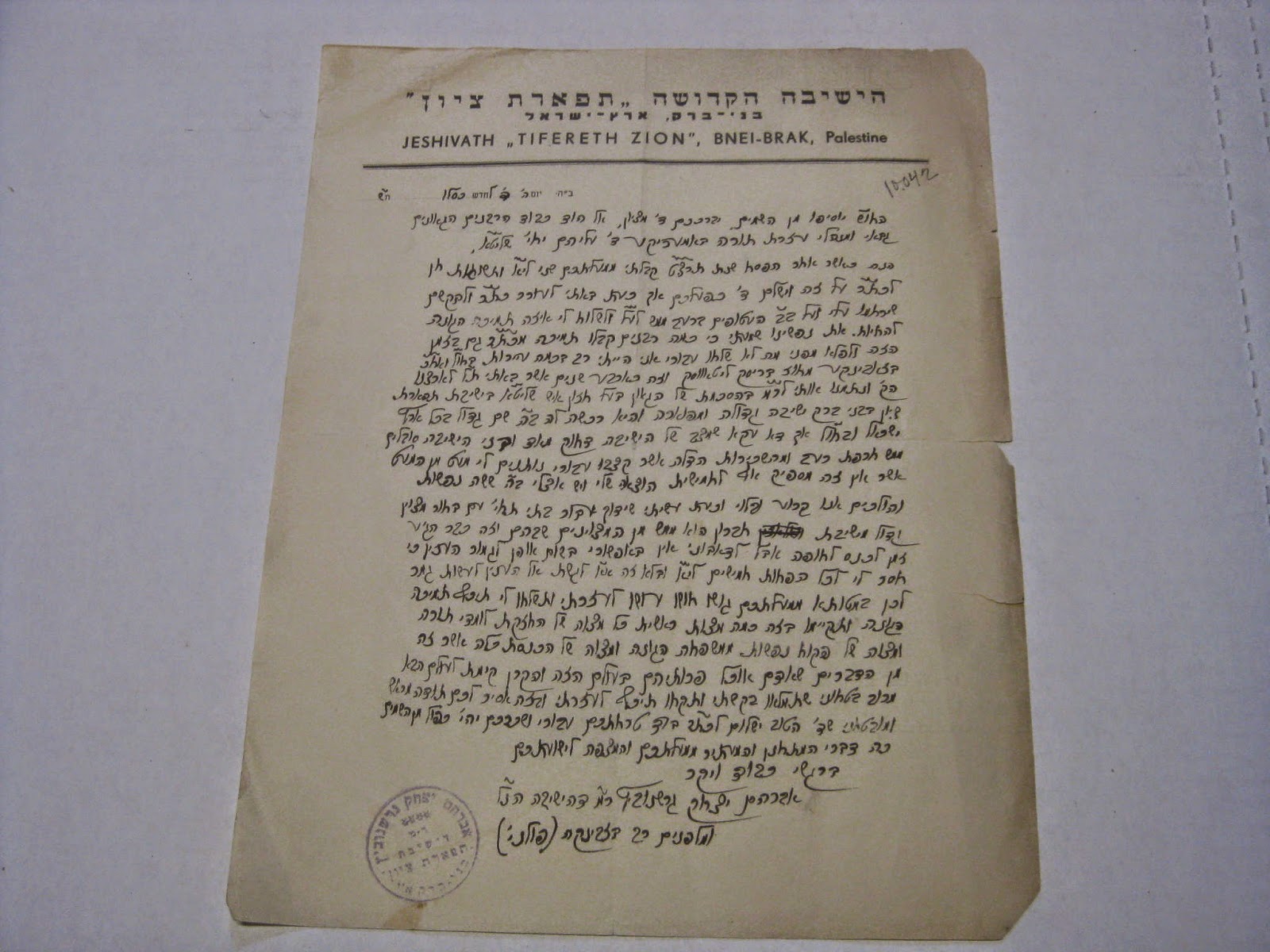
Part of a large collection of letters I recently acquired I found this interesting letter written by R. Avraham Yitzchak Gershonovitz to Rav Yosef Eliyahu Henkin and his org. the Ezrat Torah in 1940.
R. Gershonovitz writes about his financial plight. The Hazon Ish was the shadchan for his daughter, who was engaged to the then young Michel Yehuda Lefkowitz. He describes the many great qualities of the young groom and says that they were engaged for a long time and were unable to make a wedding due to the lack of funds.
It is unknown if and how Rav Henkin responded but the wedding did eventually take place but only on Lag Baomer of the year, many months after the 4th of Kislev when this letter was penned.
R. Gershonovitz writes about his financial plight. The Hazon Ish was the shadchan for his daughter, who was engaged to the then young Michel Yehuda Lefkowitz. He describes the many great qualities of the young groom and says that they were engaged for a long time and were unable to make a wedding due to the lack of funds.
It is unknown if and how Rav Henkin responded but the wedding did eventually take place but only on Lag Baomer of the year, many months after the 4th of Kislev when this letter was penned.
Subscribe to:
Posts (Atom)