Tuesday, August 12, 2014

Rabbi Yehonatan Eybeschutz's thoughts on the practice of receiving Haskamot

from the introduction of Kereti U'Peleti by Eybeschutz'

It was general practice since the early 1500s for printed works to get a הסכמה Haskamah, which served as a sorts of copyright page, often placing bans on anyone who dares print this same work within a certain time-frame.

When Eybeschutz printed his book Kereti U'Peleti, he opted out of this practice and gives an interesting logic for his reasoning. He writes that if he has yet to sell out his own copies of his printing, why would anyone else attempt to print it, when it most likely will end up as a financial failure, as he himself can't sell his copies.
If he has indeed has sold out his copies, then why stop anyone else from printing his book, as he will incur no loss from it, as his copies have already sold.

This statement of Eybeschutz, appealed to several later authors as well, and was used in several other book printings, for example the commentary on Iyov published in 1791 in Prague with a commentary by יב"א, who quotes Eybeschutz in his reasoning for not getting a Haskamah for his book.

איוב עם פרוש יב"א 1791 


Rabbi Ahron Milevsky of Montevideo, Uruguay and כרכשאות

It is interesting to see how words that haven't been used for many years manage to survive in Rabbinic circles, long after the more modern term is widely used and the old word is no longer understandable to the vast majority of the speakers of the language.

I came across recently, a letter sent from Uruguay, by Rabbi Ahron Milevsky to Rav Yosef Eliyahu Henkin in NY, dated 1957. Milevsky requested an immediate response to the Kashruth status of the wrappers of כרכרשאות sold in Uruguay by the Ford company. He attached a sample of the wrapper to the letter, having it stapled on.


The word כרכרשאות which means sausages, is derived from the Aramaic work כרכושתא, which appears in the Talmud Baba Metzia 85. The word word appears regularly in scattered Rabbinic writings, for example in the Tur Choshen Mishpat 306 והטבחים שלוקחין הכרכשתות מן הכשרות נקרא שפיר בשכר. Agnon used it once as well שהיה מכיר אפלו בתוך הקוגיל כרכשתא שנגנבה הימנו" עגנון, אלו כ

By the early 1900s the word נקניק was by the far the word that was used for sausages. נקניק appears but כרכושתא does not in Ben Yehuda, Alcalay, Megiddo and other Hebrew Dictionaries of the day. Occasionally Jews would use the old German word for sausages as well וואורשט, in some advertisements in Rabbinic Journals in the mid-1900s, you are able to see both words still in use, often together and interchangeably. Here is one such ad from Hapardes

And here is an ad page from the Journal היהודי from 1937, showing 2 different ads, one used the old term כרכשתות and the one by Hebrew National using Sausage (In Hebrew Letters) as well as the Yiddish term וואורשט

Collection of Gittin from Chernovitz (Chernivtsi) under Soviet Union 1961-1962

I recently acquired a First Edition copy of Kav Naki, a classic work on Hilchot Gittin, the Jewish Laws of divorce. The copy had the signatures and stamps of Rabbi Ezra Kalischer, the Av Bet Din in Chernovitz. There is a responsa written to him by the Maharsham, published in Shu"t Maharsham Vol 6, siman 27, dated 1897.


Upon opening the book I discovered a stash of Divorce Documents for divorces that took place in Chernovitz mostly in the years 1961-1962. Chernovitz was under Soviet Union since WWII and the writing of Gittin was more than enough to get you in trouble with the authorities, but it appears an underground Bet Din continued to be active, even under Soviet Rule.  Judging from the date, it appears the Gittin were written by a different owner of the book, other than Kalischer.
The same 2 signatures appear in nearly all the documents, that of
קלונימוס קלמן בן יחיאל מיכל
אברהם יעקב בן משה


Thursday, July 10, 2014

Rabbi Eliyahu Rusoff of the Bronx and his beating on the subway

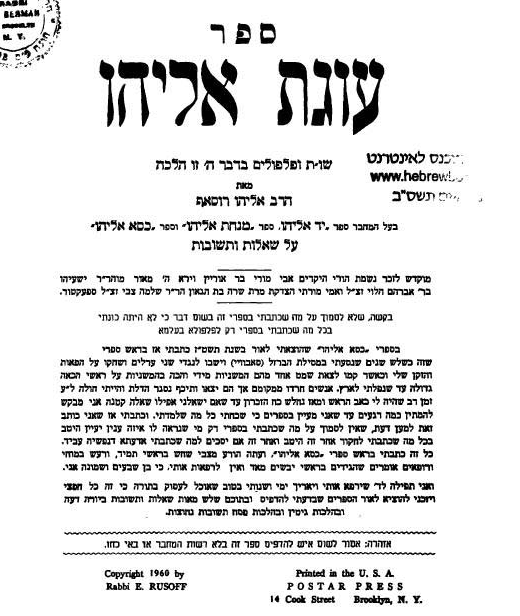
Rabbi Eliyahu Rusoff was Rabbi was in the Bronx for many years, and authored several interesting works, mostly Responsa. c1952 the Rabbi was riding on the subway and two gentiles seated facing him were poking fun at his sidelocks and beard and as they got up to leave the train, one of them took the Mishnah volume he was holding and hit him on the head with the book, hitting him so hard that he fell down. They escaped, and the Rabbi spent the next years in pain, with headaches and loss of memory.
The author printed this story that occurred to him on the title page of every book he published after this event, stating that you can not rely on anything written in the book for practical purposes as his memory is now failing and the doctors do not want to attempt to heal him as he is aged 78...


Rabbi Rusoff had an interesting style in his writing, when he would be quoting or be responding to what has been written in another book, he often quoted the entire portion word for word, often several columns long. At times, it is hard to tell where the quote ends and his comments on it begin.

Some things of note from his books:
in כסא אליהו
דף יב: discusses gentiles who kept all their utensils kosher, and then converted, can their utensils be used?
כג: is וצוונו said at the circumcision of a Convert?
ל: Is Euthanasia permitted?
לג: Would the purchase of a buyer, who was sent seforim without his request, be considered legitimate or must we suspect that he purchased it out of embarrassment (pressure)? Ref. to Minchas Eliyahu [pg. 35a]
מ: sitting shivah when one knows death of a relative is imminent.

On the title page of his Yad Eliyahu, he writes that this book was written in a response to Ba'ale Batim who complained of authors who request their help to publish works of no use to them, this work was intended and can be understood even by the layman.

One of the sponsors of the book Minchat Eliyahu is Manfred R. Lehman

hat-tip: Ovadya Hoffman
Photo hat-tip: YD Miller

Tenuvot Yehuda תנובת יהודה by Rabbi Reuven Fink An Interesting Bibliographical Note

Rabbi Reuven Fink (נולד תקצ"ה - נפטר תר"ס) authored a book titled Tenuvot Yehuda. The author writes on the title page, that any student of the talmud and it's commentaries who wants to study my book and can not afford it, shall reach out to me and I'll send him a copy for free.

The place of printing is described as Cracow, published by Yosef Fischer and dated 1896. On the title it states that the printing started in Tevet 5695 (1895) and halted in middle, until the author approached the printer Fischer in Cracow and through him the printed was completed in Adar 5696 (1896)...


At end of book, in the errata, the author writes how the mistakes are all the fault of the first publisher and for the sake of the first publisher he will not mention his name.
A look at the fonts used in the book shows that the first publisher published until page 98, the balance of book, as well as title, errata and introduction were published by the second publisher, in Cracow.


Rabbi Yedidya Tia Weil Attesting to the scarcity of Selichot following the customs of the Jews of Alsace


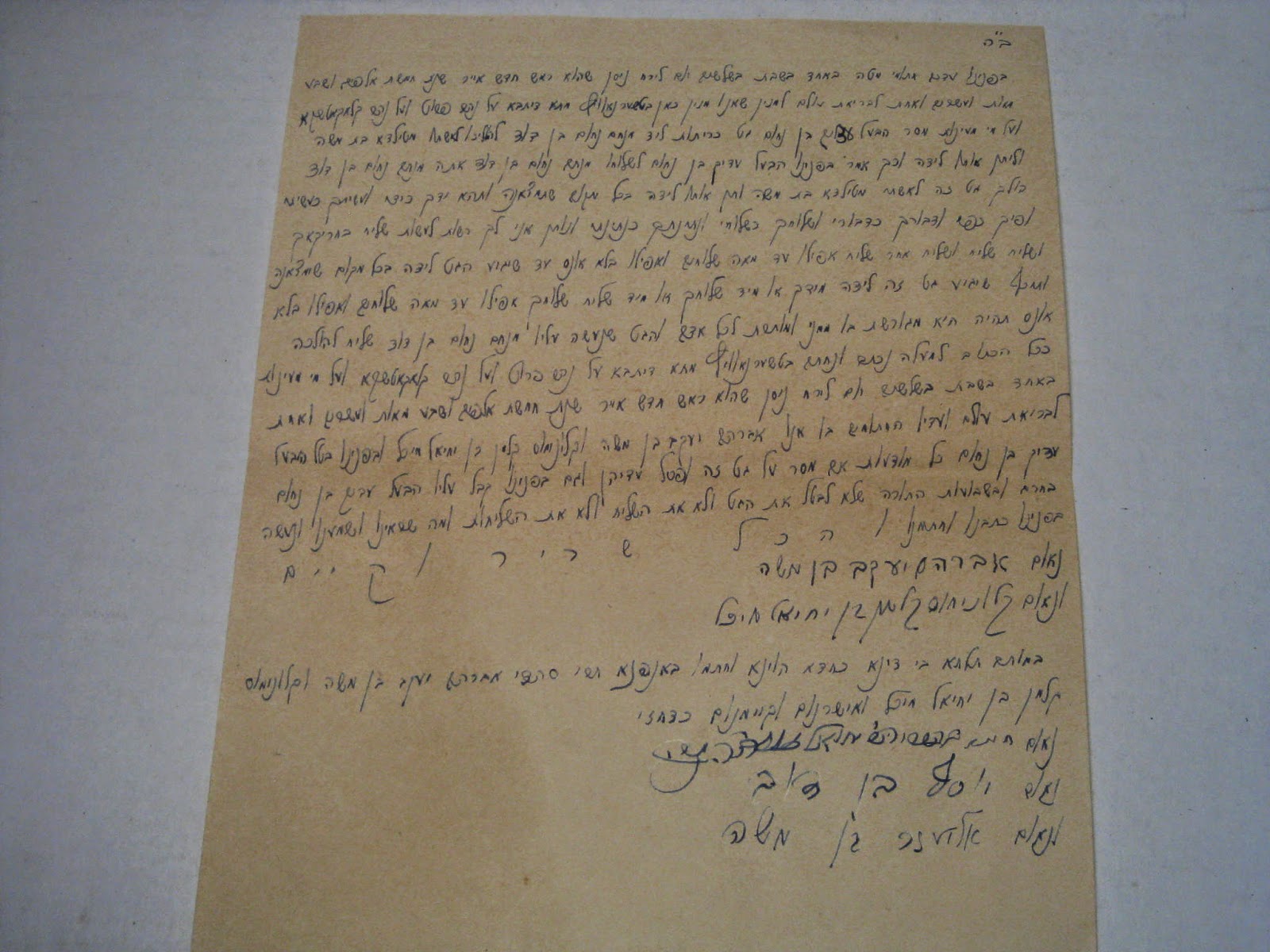
I found an interesting variant of the 1782 Sultzbach Printing of the Selichot Minhag Alsace, with an extra page preceding the title page, containing a Haskamah from Rabbi Yedidya Tia Weil, who served as Av Bet Din of Karlsruhe and Baden as successor to his father, Rabbi Netanel Weil, since 1770.
He writes in the Haskamah
"ספו תמו אף הבלאות... Even tattered copies have been depleted"
Selichot with Alsace Minhagim have been published before this edition several times, including in 1722, 1750 and 1756 in Amsterdam and Fuerth.

Thursday, May 15, 2014

A Self-Censored copy of Lev Haivri לב העברי by Akiva Yosef Shlesinger, Ungvar 1864

I recently acquired a copy of the first edition of Lev Haivri by Akiva Yosef Shlesinger, a commentary on the will of the Chatam Sofer. A previous owner of the book apparently found several passages of the book not to his liking and these passages were neatly burned out.
several lines burned out in this copy of לב העברי


The offending lines describe a story in the name of the Chatam Sofer, where he stated that if a Jew decides that he will no longer be religious, it is preferable if he converts to Christianity.


The censored text, from a later edition

Recent Acquisition: The library of Rabbi Dr. H. Norman Strickman

Rabbi H. Norman Strickman is Rabbi emeritus of Marine Park Jewish Center, Professor of Jewish Studies at Touro College and past president of the Rabbinic Board of Flatbush. He received his M. H. L. from Yeshiva University, a Phd from Dropsie University and was ordained at Rabbi Isaac Elchanan Seminary. He is the recipient of the Histadrut Haivrit prize in Hebrew Literature and his writings have appeared in Jewish Quarterly Review, Midstream, Bitzaron and Hadarom. He has also translated and annotated Ibn Ezra's commentary on the Pentateuch, Psalms and the Yesod Mora.
Rabbi Strickman is currently in the process of making Aliya to Israel.

Rabbi Strickman's large library consists of several thousand books including nearly any book a Scholar of the Bible and Jewish History will ever see quoted as well as an astounding selection of books a Pulpit Rabbi would find of use. All politics and debates were aside in his library where books were judged by what can be learned from them and not by political considerations. A splendid collection of books that can only be built through decades of searching for and building book by book. Best wishes to Rabbi Strickman and his family upon their Aliya.

One of the many books published by Rabbi Strickman

Recent Acquisition: The library of Rabbi Dr. Stanley Greenstein

Rabbi Dr. Stanley Greenstein with his wife, Judy

Rabbi Dr. Stanley Greenstein, studied at the Jewish Theological Seminary and received Rabbinic ordination at Leo Baeck College in London. Rabbi Greenstein served many congregations in the World during his long career, including in Shreveport, Louisiana; Salt Lake City and at the Laurelton Jewish Center. Rabbi Greenstein was also Professor of Theology and Religious Studies at St. John's University. Born in to a family of Rabbis, his father, a graduate of the 1930 JTS class, Rabbi Manuel Greenstein, was Rabbi for many years in West Palm Beach, FL as well as serving congregations in Steubenville, Ohio; Battle Creak, Michigan and Gloversville, NY. His grandfather, Rabbi Samuel Greenstein was Rabbi in Warren, Ohio. Rabbi Greenstein passed away in March of this year, he was 79.

There are two types of people in the world, those who love and read books and those who do not understand them. Rabbi Greenstein could have made a perfect poster boy for the former, a true booklover. His home, seemed to have been a home for his books first and family second. Every available space contained a neat bookshelf with books. His wife related how they stopped counting their books when they surpassed 10,000 volumes.

Every book was used. There was scarcely a book in the house that did not hold several bookmarks. Nearly every Scholarly Jewish Book published in the last 100 years reached his collection, with a special focus on Jewish History, from the very ancient to the Holocaust and Israel. A product of the early JTS, his library reflected his extensive study of all Rabbinic texts, with a library that would not feel lost in a Hasidic Yeshiva in Williamsburg. Of note, was the timelessness of the books purchased, with books from the early 1900s as well as many books published in the last decade. May his books serve as his memory.


Sunday, May 11, 2014

An Interesting Dedication in Na'eh Doresh נאה דורש by Rabbi Gedaliah Silverstone 1938

In 1938 Rabbi Gedaliah Silverstone published one of his many sermon books, titled Na'eh Doresh. The book includes an interesting dedication to the author's grandson, an interesting look at the massive generation gap between the young American Born grandchild and the European trained Rabbi who was his grandfather


dedication in honor of the author's grandson
Rabbi Silverstone writes in the dedication: "Just as our father Yaakov, blessed his grandchildren the sons of Yosef with the blessing of the Guardian Angel...that they shall not be ashamed of their Hebrew names, so too I shall bless you my dear grandson, that from now on your name shall be Yitzchak and not Elwood, and you shall keep the commandment of wearing Tefillin every day (aside from Shabbat and Yom Tov)..."

The thought that the Chief Rabbi of Washington D.C. had to inform his grandson not to wear his Tefillin on Shabbat and Yom Tov is quite amazing to me.


Dedication in Peninim Yekarim by Rabbi Gedaliah Silverstone
Above is another dedication in another book of Rabbi Gedaliah Silverstone. The wording is rather unusual  הספר הזה מוקטר ומוגש למנחה ולמזכרת עולם . Though the word would be more appropriate when used to remember a deceased, it appears the blessing was for a young man, alive and well....

From Wiki: R. Gedaliah Silverstone (1871, Jasionowka, Poland - 1944, Jerusalem, Palestine) was a prominent Orthodox rabbi and author in the United States at the beginning of the twentieth century.
R. Gedaliah b. Isiah Meir Silverstone, Chief Rabbi of Washington D.C. He was born in 5631 [1871] in Jasionowka, Poland, where his maternal grandfather was the rabbi. At the age of two, he moved to Sakot, Kovno Province, where his father served as a rabbi. Silverstone studied in the yeshivot in Ruzhany and Telz until 1891, when his father moved his family to Liverpool. Silverstone was appointed the rabbi of the Orthodox Congregation of Belfast in 5661 [1901]. He visited America in 5665 [1905] to sell his books. The following year he decided to settle there because he could not support his large family in England and he was appointed rabbi of the Combined Congregations of Washington, D.C. R. Silverstone, a popular rabbi, was on good terms with his congregants.
As opposed to other American rabbis of the period, his publishing endeavors were supported by the community at large and he issued pamphlets of sermons on an almost annual basis. He had little difficulty in attracting benefactors to defray the publishing costs. R. Dov Ber Manischewitz of Cincinnati and Noah [Nathan?] Musher were among his patrons and he repeatedly reported that his works were eagerly sought after by preachers. He generally published only sermons because he knew that most American Jews would not read his more scholarly works and because "many rabbis and sages from other states [or countries?] write to me that my approach to aggadah is the only one that can be used to influence the masses and lure them to their Father in heaven" (Mesamhai Lev, St. Louis 1925, pp. 5–6). A vocal opponent of non-Orthodox synagogues, seminaries and rabbis, his sermons contain many polemical statements.
R. Silverstone was a vice president of the Agudath Harabbonim, a director of the Hebrew Sanitarium of Denver and the Hebrew Home for the Aged of Washington, D.C., and a member of B'nai B'rith. He also founded the first talmud torah in Washington, D.C. and many of his sermons refer to the poor state of Jewish education. An active Zionist, Silverstone attended the Sixth Zionist Congress (1903) as a delegate from Belfast. He later sent two of his sons to study in Jerusalem and, after visiting the Land of Israel ca. 1921, he announced that he would soon be immigrating there (Darke be-Kodesh, St. Louis 1922, pp. 4, 6). Though he was unable to carry out his plans right away (Doresh Tov, St. Louis 1923, p. 5), he did visit again within a year, this time together with R. Zevi Hirsch Masliansky.
He finally settled in Jaffa by Elul of 1923 and he was invited to preach a number of times at the Neveh Tzedek synagogue. A few months later, however, he was compelled to return to Washington because his wife became ill. Attempts to settle in Safed in 1936 and in Jerusalem in 5698 [1938]-5699 [1939] failed as well and he returned to America each time. He returned once more a few years later, this time remaining until his death in 1944. R. Silverstone was a grandson of R Elijah Abramsky; a nephew of R Hayyim Zevi Hirsch Braude; the father of R. Dr. Harry Silverstone; a cousin of R Zelig Reuben Bengis; and an in-law of R Gershom Ravinson of Cleveland.


A reader has since emailed me the following corrections to the above biography of R. Silverstone incorporated from Wikipedia:
To the best of my knowledge he never studied in Ruzhany.  At around the age of 12 and before he went to Telz, he studied in what today would be termed a Yeshiva Ketana in the Lithuanian town known to Jews as Rassein  (need to check the official name.  I think it was something like Rossieny under the Russians and, then, Rasseiniai under the Lithuanians, but this needs checking).  There seems to be confusion here between to not-too-differently sounding names.  My source for this is Silverstone’s handwritten autobiography of which I have a copy.

For the sake of accuracy, Rabbi Silverstone was a cousin by marriage of Rabbi Z R Bengis.  Rav Bengis’ first wife was a daughter of R’ Chaim Zvi Hirsh Broide and R’ Silverstone was a son of R’ CZHB’s brother R’ Yeshaya Meir Silverstone, so R’ Gedaliah and Rebbetzin Bengis were first cousins.

Rabbi Ravinson’s first name was GershoN not GershoM!  Incidentally, he was a Rav in Liverpool before Cleveland (where he passed away and is buried) and that’s how he became personally acquainted with the Rabbis Silverstone, father and son.

The final words of the piece are “and an in-law of Rabbi Gershom Ravinson of Cleveland ”.  A basic knowledge of the relative ages and family situations of these 2 Rabbis shows that it’s physically impossible for them to have been “in laws”!  This error arises from the mysterious use of the term “mechutani” by R’ Ravinson in his haskama to R’ Silverstone’s “Pirchei Oviv” published in 5661 when R’ Gedaliah Silverstone was serving in his first rabbinical position in Belfast.  R’ Silverstone was then aged about 30 and had a few very young infant children.  There is no way “mechutani” here could have the conventional meaning of being parents of a young couple.  The usage out of the conventional context is rare but not unique and R’ Ravinson means they were connected via marital relationships.  It wasn’t they had no relationship but, on the other hand, they had no “blood” relationship.  I assume that the latter was the reason he didn’t use the more conventional Shin”Bet (she’er besori”) as they were not really related.  Their family connection was convoluted and connected to the Latvian Tsiuni rabbinic family.  I don’t have the details to hand and they’re not really relevant.